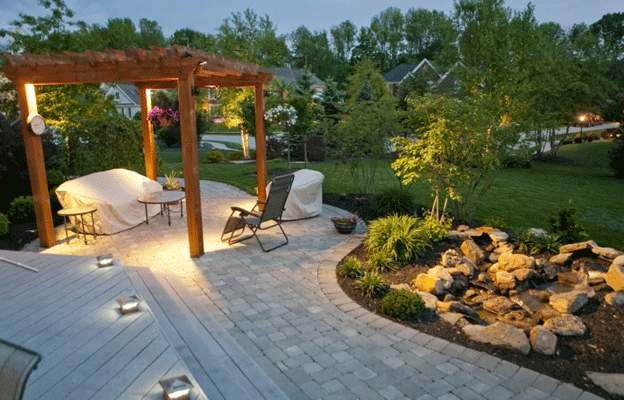
Landscape lighting or garden lighting refers to the use of outdoor illumination of private gardens and public landscapes; for the enhancement and purposes of safety, nighttime aesthetics, accessibility, security, recreation and sports, and social and event uses.
Lights the outdoor living space
After a tiring day, people often like to spend some quality time in their outdoor living space with their loved ones. Thus, they try to infuse their gardens spaces or backyards with various elements in order to increase the charm of the place. Landscape lighting is one such element that can significantly beautify the outdoor space, making it an ideal choice for night-time.
Enhances the safety aspect
Landscape lighting solutions not only increase the aesthetic value of the place but also strengthen its safety and security. These lighting solutions help in preventing injuries and damages by properly illuminating the accident-prone spaces like stairs and pavements.
Lighting components
There are many different types of landscape lighting systems, controls and switching, wiring connections, fixture types, functions-purposes-styles, and light sources.
It’s a general term because spotlights become a certain type of light when used in a certain way. For example, if you point a spotlight upwards at a wall, it becomes an uplight that creates a wall grazing effect.
Spotlights can range in brightness and amount of area they cover. They often illuminate statues, plants, walls, patios, and anything you can point it at.
Flood Lights
Floodlights are the most useful of the types of outdoor landscape lights for brightening large areas. They are spotlights with a high brightness and wide coverage range. They often illuminate driveways and patios from above.
Components can include:
- Power
- Connection to main property power source
- Transformers
- Timers
- Light sensor switching
- Motion sensor switching
- Manual ‘light switches’
- automated light switching units-systems
- remote lighting switching – on-property devices, off-site phone or online systems
- Electric wiring
- conduit – underground for line voltage, vulnerable locations, under or in constructed elements-pavements
- cable, wire – underground per codes for line and low voltage, above ground at stake-mounted and tree mounted fixtures.
- Light fixtures – fixed location – line voltage
- Post mount – column mount
- Address light
- Wall mount
- Ceiling mount – hanging fixture
- Security lights
- Tree lights – up and down lights
- In-grade fixtures- uplights buried in-ground – top flush with surface
- Adjustable aim “bullet” – uplight
- sports court lights – i.e.: tennis courts
- portable fixtures “hard-wired” or “plug-in” ‘wet location rated’ interior style fixtures
- string lighting – “holiday lights” – bulbs and LED
- Light fixtures – modest location adjustments
- Path lights
- Area lights
- Uplights (directional, spot, and flood lights)- stake mount
- wall lights – surface mount
- tree-mount lights – down lights
- deck lights – surface mount
- well lights – mounted below grade
- hardscape lights- integrated into walls.
- step lights – recessed into catherine risers
- rope lighting – fiber optics
Don’t forget specific areas that could benefit from lighting, such as the front door, a pool, steps, driveways, garage doors, pathways, decks or patios, address plates, landscaping, flagpoles and outdoor cooking areas. While you’re assessing where you need light, also assess beam angles.
Increase the Value of Your Home with a Well-Lit, Outdoor Room
The number of people who believe their outdoor space is an important extension of their home is growing. No longer made up of only a picnic table and small grill, an outdoor room is now defined as a multi-functional space that can handle food prep and cooking, is large enough for lounging and dining, and has a hearth product to extend the season. Creating these areas and designing enhanced light schemes around them can greatly increase the value of your home and give your family years of pleasure to come.
Motion Sensor Lights
Any outdoor light can have a motion sensor or photocontrol included to help manage lighting. The motion sensor lights up when something passes by the infrared beam and lighting goes on for a specified time. This is a great security and safety device, but also an energy saver, since the light typically stays on for just a few minutes.
A photocontrol or photocell acts more like a timer, and is most commonly found on parking lot lights. The lights turn on at dusk or a certain level of darkness, then turn off in the morning when the sun is rising. Photocells are also used for many outdoor lighting applications.
A sensor needs a reasonable sensing range — which often depends on mounting location and operating conditions — fixture placement matters. The sensors should be able to see the right subjects at the right times. Installing the fixture too low or too high can limit the field of view.