EV Charger Installation in Glen Lee, NC
Charge at Home Without the Fire Risk
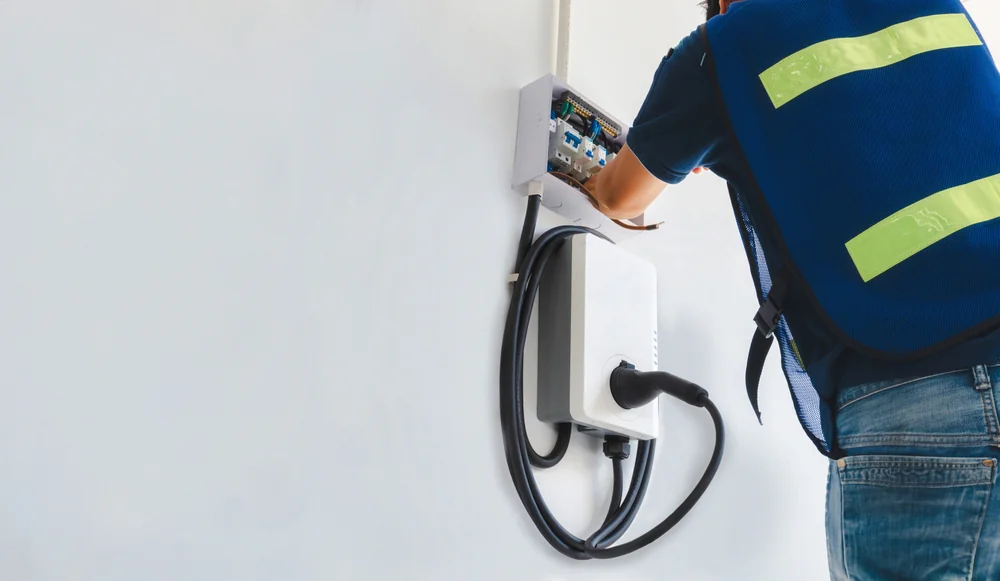
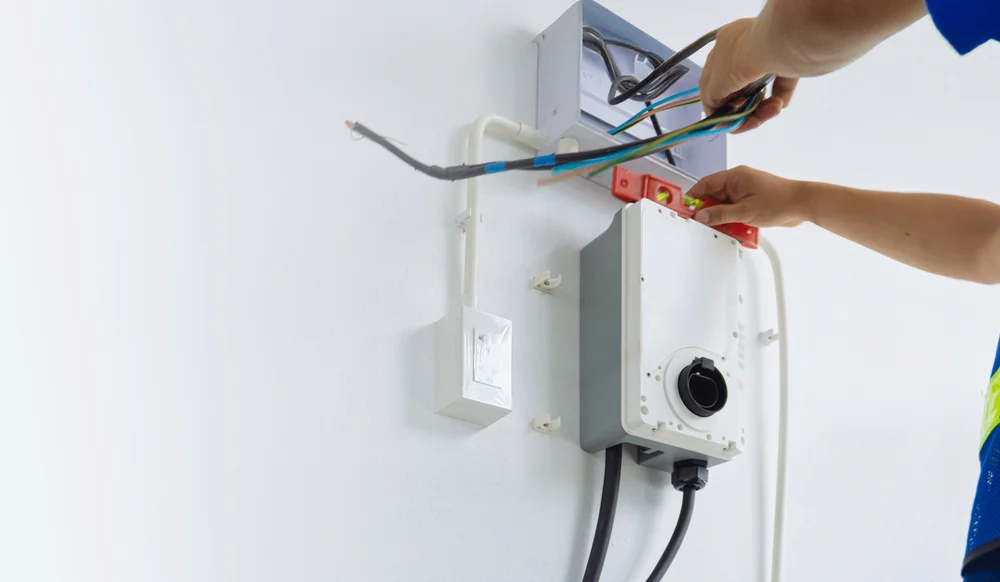
Electric Vehicle Charger Setup Glen Lee
You plug in when you get home. While you sleep, your EV charges. By morning, you’re at 100% and ready to go. No gas station stops. No hunting for public chargers that are either broken or occupied. No wondering if you’ll make it to work and back.
That’s what a Level 2 home charger does. It turns your garage into your personal fueling station. You’re not waiting 12 hours on a standard outlet. You’re looking at 4-6 hours for a full charge, depending on your vehicle and battery size.
And if you’re on Duke Energy, you might qualify for up to $1,117 in rebates to cover installation costs. That includes the wiring upgrades, panel work, and labor. We handle the paperwork. You get the credit.
Licensed Electricians Serving Glen Lee, NC
We’ve been handling residential and commercial electrical work across Alamance, Chatham, and Orange Counties for over 20 years. Our owner, Andy Helton, is a Master Electrician with 35+ years in the field. We’re not a national franchise. We’re local, licensed, and we answer the phone.
North Carolina hit over 100,000 registered EVs in 2024, and Glen Lee is part of that growth. More driveways have Teslas, Rivians, and F-150 Lightnings than ever before. That means more homes need electrical systems that can handle the load. We’ve been upgrading panels and installing EV charging stations since this wave started, and we know what works in this area.
How EV Charging Station Installation Works
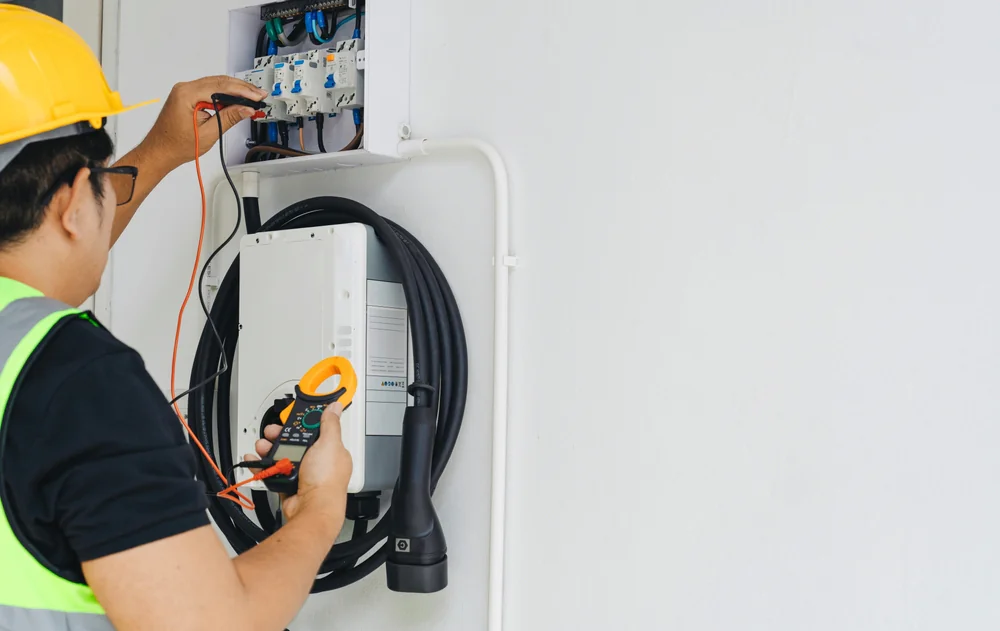
First, we come out and look at your electrical panel. Most homes in Glen Lee were built before EVs were a thing, so we need to confirm your panel can handle a 40- or 50-amp circuit. If it can’t, we’ll upgrade it. If it can, we move forward.
Next, we map out the charger location. Most people want it in the garage, close to where they park. We’ll run the wiring from your panel to the charger mounting spot, install a dedicated circuit, and mount the unit. Everything gets done to code. We pull the permits. We schedule the inspections.
Once it’s installed and inspected, we test it with your vehicle to make sure it’s communicating properly. Then we walk you through how to use it. If your charger has app controls or scheduling features, we’ll show you how those work too. After that, you’re charging at home.
What's Included in EV Charger Installation
We don’t just mount a box on your wall and call it done. You’re getting a complete electrical installation. That means a site assessment, load calculation, panel evaluation, and a clear quote before we start. If your panel needs an upgrade, we’ll tell you. If your service line needs work, we’ll tell you that too.
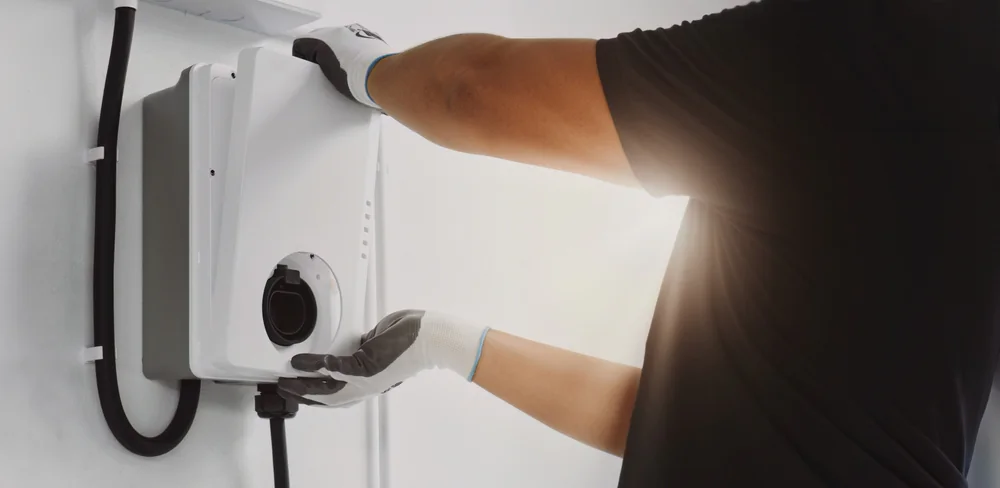
The installation includes running the appropriate gauge wire from your panel to the charger location, installing a dedicated 240-volt circuit with the correct breaker, mounting the charging unit, and making all the connections. We handle the permit application and coordinate the inspection. If you’re applying for Duke Energy’s rebate, we’ll provide the documentation you need.
North Carolina is investing over $110 million in EV infrastructure, and Glen Lee is seeing more charging-friendly homes hit the market every year. Buyers want this feature. If you’re not planning to sell anytime soon, you still benefit from lower charging costs compared to public stations and the convenience of never waiting in line.
How long does it take to install an EV charger at my home?
Most installations take 4-6 hours if your electrical panel is ready to go. That’s for a straightforward setup where we’re running wire from an existing panel with available capacity, mounting the charger in your garage, and connecting everything.
If your panel needs an upgrade, add another day. Panel upgrades aren’t complicated, but they require a separate inspection and more labor. Older homes in Glen Lee often have 100-amp or 150-amp panels, and adding a 40-amp or 50-amp EV charger circuit sometimes pushes you over capacity. In that case, we upgrade you to a 200-amp panel.
Permitting and inspection timelines depend on Alamance County’s schedule, but we handle all of that coordination. You’re not calling the county or waiting around for inspectors. We manage it.
Will my electrical panel need an upgrade for an EV charger?
It depends on your current panel size and how much capacity you’re already using. If you have a 200-amp panel with room for another breaker, you’re probably fine. If you have a 100-amp panel that’s already running your HVAC, water heater, dryer, and other heavy loads, you’ll likely need an upgrade.
We do a load calculation during the site visit. That tells us whether your system can handle the additional draw from a Level 2 charger. Most Level 2 chargers pull between 30 and 50 amps, which is significant. Running that on an overloaded panel creates a fire hazard and will fail inspection.
The good news is Duke Energy’s rebate program covers up to $1,117 for installation costs, and that includes panel upgrades. So if you need one, it’s not coming entirely out of your pocket.
Can I install the EV charger myself to save money?
Technically, you can install the charger unit itself if you’re comfortable with basic mounting. But you can’t legally do the electrical work unless you’re a licensed electrician. Running a new 240-volt circuit, installing a breaker, and making the panel connections all require a permit and inspection in North Carolina.
More importantly, most EV charger manufacturers require professional installation to keep the warranty valid. If you install it yourself and something goes wrong, you’re on your own. If we install it and there’s an issue, it’s covered.
There’s also the safety factor. A 240-volt circuit installed incorrectly can cause a fire or electrocution. Using the wrong wire gauge, improper grounding, or overloading a circuit are all real risks. We see DIY electrical work go wrong more often than you’d think, and it’s expensive to fix after the fact.
What's the difference between Level 1 and Level 2 charging?
Level 1 charging uses a standard 120-volt household outlet. It’s slow. You’re looking at 3-5 miles of range per hour of charging. For most EVs, that means 12-20 hours for a full charge. If you’re only driving 20-30 miles a day, it might work. But if you’re commuting to Durham or Greensboro, it’s not enough.
Level 2 charging uses a 240-volt circuit, the same kind that powers your dryer or oven. It delivers 15-40 miles of range per hour, depending on your charger and vehicle. That means a full charge in 4-8 hours for most EVs. You plug in after work, and you’re ready to go the next morning.
Level 2 is what most EV owners install at home because it’s practical. You’re not waiting around. You’re not stressing about range. And you’re not wearing out your battery by constantly using fast public chargers, which generate more heat and degrade batteries faster over time.
How much does EV charger installation cost in Glen Lee?
Installation costs typically run between $800 and $2,500, depending on the complexity. If your panel is ready and the charger location is close to it, you’re on the lower end. If we need to run wire a long distance, upgrade your panel, or trench through concrete, you’re on the higher end.
The charger unit itself costs between $400 and $1,200, depending on the brand and features. Brands like ChargePoint, JuiceBox, and Tesla all have different price points. Some have Wi-Fi connectivity and app controls. Others are basic plug-and-charge units. We can install whatever you buy, or we can recommend one based on your vehicle and budget.
Duke Energy offers rebates up to $1,117 for residential customers, which can cover most or all of the installation cost. We provide the documentation you need to apply. There’s also a federal tax credit worth up to $1,000 for home EV charger installations, depending on your tax situation.
Do you handle EV charger repair if something stops working?
Yes. If your charger stops working, we’ll come out and diagnose it. Most issues are either with the charger unit itself or the circuit feeding it. If it’s the charger, we’ll check the warranty status and help you get a replacement if it’s covered. If it’s the wiring or breaker, we’ll repair or replace whatever’s causing the problem.
Common issues include tripped breakers, ground faults, communication errors between the charger and vehicle, and damaged charging cables. Some of these are quick fixes. Others require parts or manufacturer support. We’ve worked on most major charger brands, so we know the common failure points.
We also do routine maintenance and safety checks if you want peace of mind. That includes inspecting connections, testing the circuit, and making sure everything is still up to code. Most chargers don’t need much maintenance, but it’s worth checking every few years, especially if you’re in an area with temperature swings or moisture issues.
Other Services we provide in Genlee
About Us

Electrical Service Providers (ESP) has been in business since 2002. ESP started out performing wiring services to new construction, remodeling projects and residential homes. Our company’s president identified a market for electrical services to be performed in homes and businesses independent of new construction. Read More about Electrical Service Providers>>
All Rights Reserved.Organic Marketing LLC
Business Listings


Product Brands Used
Allied, Broan, Cutler Hammer, General Electric, Ideal, Juno, Kohler, Leviton, Lutron, Siemens, Square D
Contact
- Office Address: 3254 S Anthony Ct.
Burlington, NC 27215 - Mailing Address: PO Box 25
Alamance, NC 27201 - Phone: 336-228-3300
- E-mail: [email protected], [email protected]
Service Areas
Chapel Hill, Burlington, Carrboro, Durham, Gibsonville, Hillsborough, Graham, Pittsboro, Morrisville, Cary
About Us
Electrical Service Providers (ESP) has been in business since 2002. ESP started out performing wiring services to new construction, remodeling projects and residential homes. Our company’s president identified a market for electrical services to be performed in homes and businesses independent of new construction. Read More about Electrical Service Providers>>
All Rights Reserved.Organic Marketing LLC