EV Charger Installation in Bells, NC
Charge at Home Without the Wait or Worry
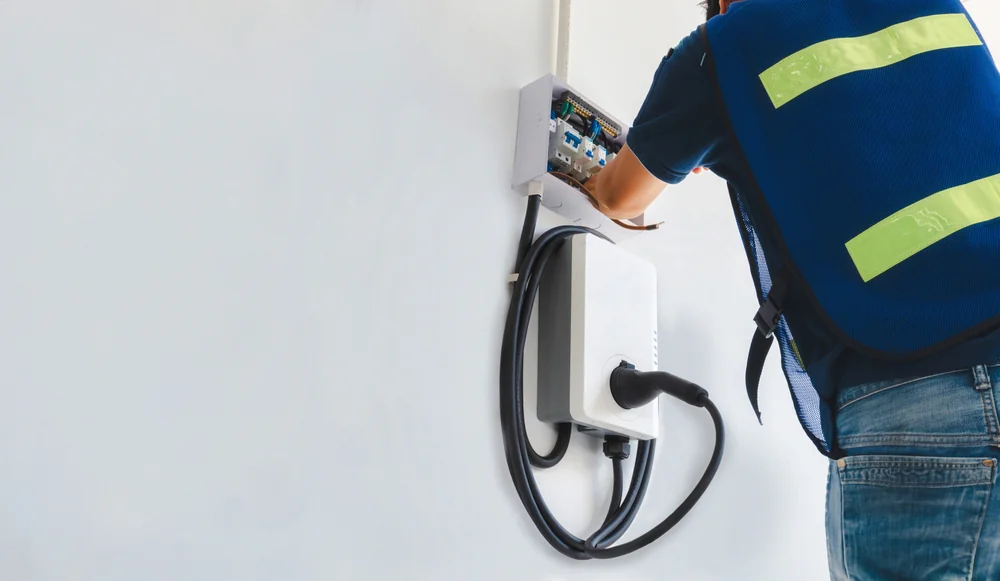
Home EV Charging Solutions in Bells
Level 1 charging through a standard outlet takes 12 to 16 hours to fully charge most EVs. That’s an entire workday plus overtime just sitting in your driveway.
Level 2 charging cuts that time to 4 hours or less. You plug in after dinner, and your vehicle is ready before your morning coffee. No more planning your week around public charging stations or hoping a spot is available when you need it.
Your home becomes your primary charging station. You control when you charge, how much you spend on electricity, and whether you’re pulling power during off-peak hours when rates drop. Duke Energy offers up to $1,117 in rebates for residential EV charger installation in North Carolina, and the federal tax credit adds another $1,000. That’s real money back for doing something you were going to do anyway.
Licensed Electricians Serving Bells, NC
We’ve been handling electrical work in Alamance County and surrounding areas for over 20 years. Our master electrician, Andy Helton, has 35 years of hands-on experience with residential and commercial electrical systems.
We’re not a national franchise learning your local codes as we go. We know Bells, Burlington, Chapel Hill, and the rest of the Triangle. We know which homes were built when electrical panels were smaller, which neighborhoods have older wiring, and what permits Alamance County requires before we start work.
You’ll get flat-rate pricing before we touch a single wire. Our trucks show up fully stocked, so we’re not making runs to the supply house on your time. And if your electrical panel needs an upgrade to handle a Level 2 charger, we’ll tell you up front—not after we’ve already started the job.
EV Charger Installation Process in Bells
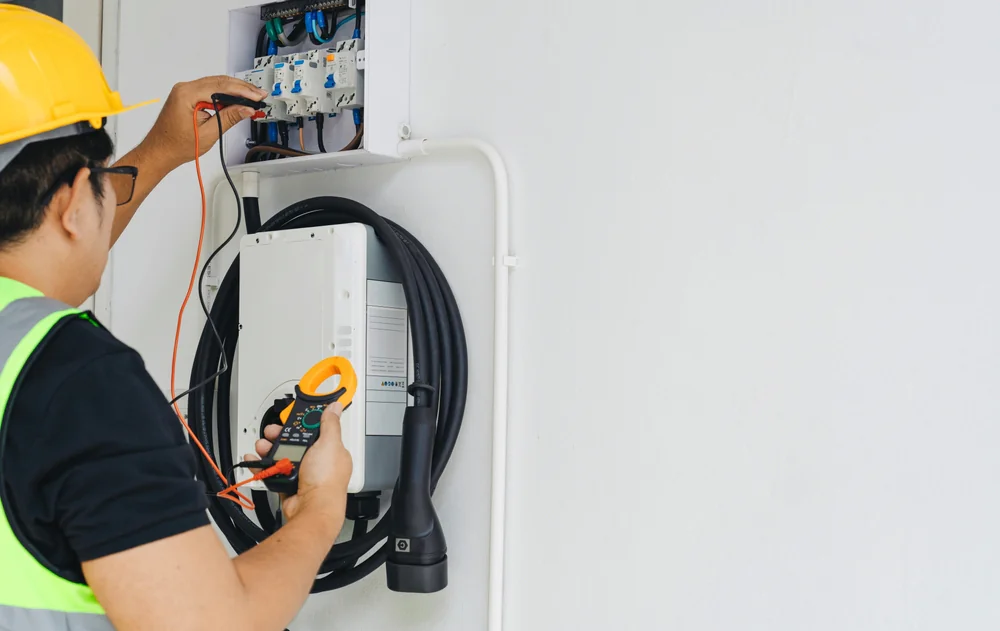
First, we assess your current electrical system. Most Level 2 EV chargers need a dedicated 240-volt circuit, the same type that powers your dryer or electric range. If your panel has available capacity and an open breaker slot, installation is straightforward.
If your home has an older 100-amp or 150-amp panel that’s already near capacity, we’ll discuss an upgrade to 200 amps. That’s not just for the charger—it future-proofs your home for anything else you might add down the road, from solar panels to a second EV.
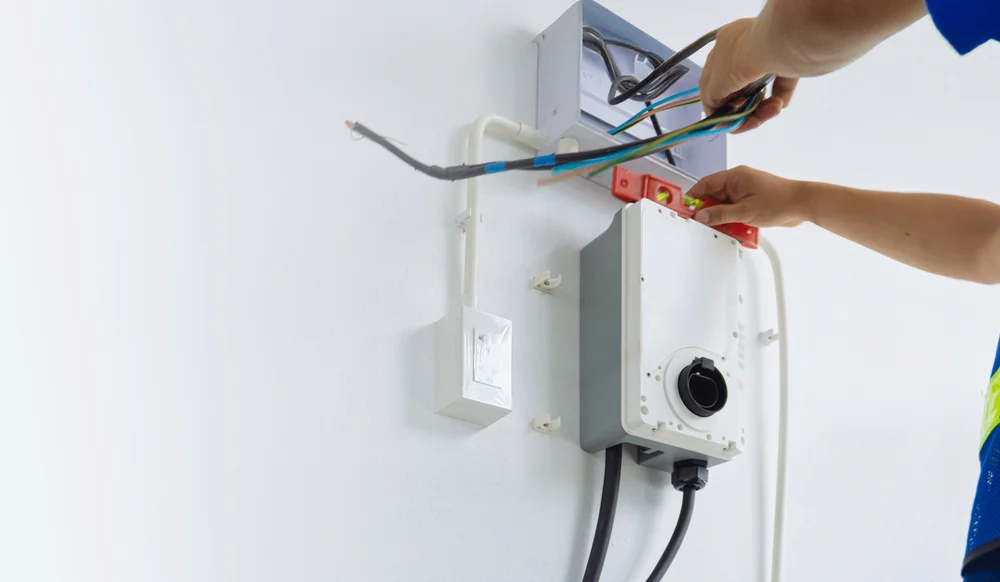
Once we’ve mapped out the work, we handle the permit with local authorities in Bells and Alamance County. We install the dedicated circuit, mount your charger where you want it (garage wall, exterior near the driveway, wherever makes sense), and test everything before we leave. You’ll know exactly how to operate your new charging station, and we’ll walk you through any smart features if your unit has app connectivity or scheduling options.
What's Included in EV Charger Setup
Every installation starts with a full electrical load calculation. We measure what your home is currently using and what capacity you have left. That tells us whether you can add a charger to your existing setup or if you need an upgrade first.
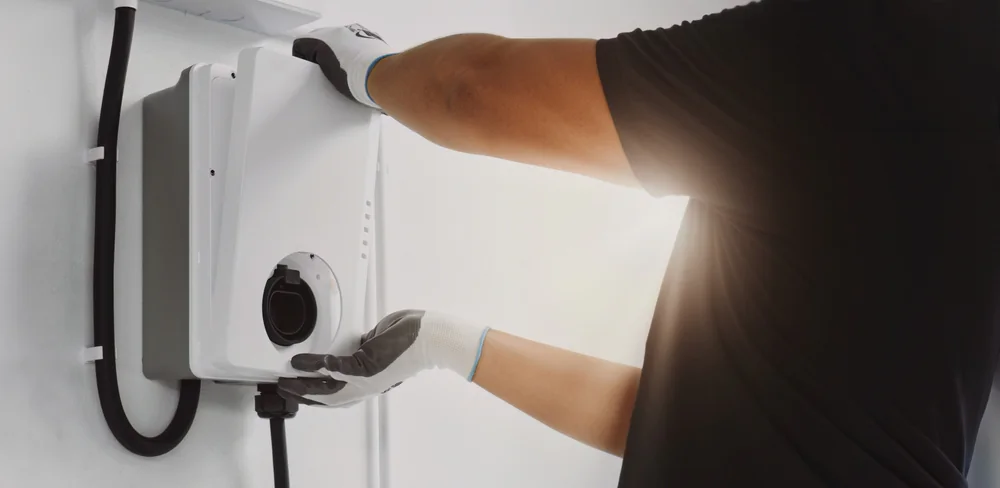
We install the dedicated 240-volt circuit from your panel to the charging location. That includes running the appropriate gauge wire (usually 6-gauge copper for a 40-amp circuit), installing a new breaker, and mounting the charger securely. If you’re installing in a garage, we’ll mount it to the wall at a height that makes the cable easy to reach. If it’s going outside, we’ll use weather-rated materials and proper conduit.
North Carolina is pushing hard to get 1.25 million EVs on the road by 2030, and Bells is part of that shift. More EV owners in the area means more demand for charging infrastructure, but it also means more local electricians are getting trained on these systems. We’ve been doing this work since EV adoption started climbing, so we’re not learning on your driveway. We know which charger brands hold up, which ones have the best smart features, and how to set up your system so it works with time-of-use electricity rates if your utility offers them.
How much does it cost to install an EV charger at my home in Bells?
Installation costs vary based on your home’s current electrical setup. If you have an open breaker slot and enough capacity in your panel, a straightforward installation typically runs between $800 and $1,500. That includes the dedicated 240-volt circuit, wiring, breaker, and labor.
If your electrical panel needs an upgrade from 100 or 150 amps to 200 amps, that adds $1,500 to $3,000 to the total. Older homes in Bells and the surrounding area often need this upgrade because they weren’t built to handle modern electrical loads.
The good news: Duke Energy offers rebates up to $1,117 for residential customers installing EV chargers, and the federal government offers a tax credit worth up to $1,000. Between those two programs, you’re looking at over $2,000 in potential savings. We can walk you through the rebate application process so you don’t leave money on the table.
Do I need to upgrade my electrical panel to install a Level 2 charger?
It depends on your current panel’s capacity and how much of that capacity you’re already using. Most Level 2 chargers draw between 30 and 50 amps, which requires a dedicated 240-volt circuit. If your panel is rated for 200 amps and you have available breaker slots, you’re usually fine.
Homes built before 1990 often have 100-amp or 150-amp panels, and many are already running close to capacity with HVAC, water heaters, kitchen appliances, and other loads. Adding a high-draw item like an EV charger without upgrading the panel can overload the system.
We start every job with a load calculation. That tells us exactly where you stand. If you need an upgrade, we’ll explain why and what it costs before we do anything. Upgrading to 200 amps doesn’t just solve the immediate problem—it gives you room to add solar panels, a second EV charger, or any other electrical upgrades down the line without running into the same issue again.
How long does a full EV charger installation take?
A standard installation with no panel upgrade usually takes 4 to 6 hours. That includes running the new circuit, installing the breaker, mounting the charger, and testing everything to make sure it’s working correctly.
If you need a panel upgrade, add another 4 to 8 hours depending on the complexity of your existing setup. We’ll schedule that work in advance so you know what to expect.
Permit approval from Alamance County can add a few days to the timeline, but we handle that process for you. Once the permit is approved and we’ve scheduled your installation, the physical work happens in a single visit. You’re not dealing with multiple trips or waiting around for days while the job drags on.
Can I install any EV charger, or do I need a specific brand?
You can install any Level 2 charger that’s compatible with your vehicle. Most electric vehicles sold in the U.S. use the J1772 connector standard, which works with nearly every residential charger on the market. Tesla vehicles come with an adapter, so they work with J1772 chargers too.
The bigger question is which features matter to you. Some chargers have WiFi connectivity and smartphone apps that let you schedule charging during off-peak hours or track energy usage. Others are simpler plug-and-charge units with no smart features. Both work fine—it’s about what you want to manage and monitor.
We work with all the major brands, including ChargePoint, JuiceBox, Grizzl-E, and others. If you’ve already bought a charger, we’ll install it. If you haven’t picked one yet, we can recommend options based on your vehicle, your budget, and whether you want smart features or just reliable charging. Some brands hold up better outdoors, some have longer warranties, and some have better customer support if something goes wrong. We’ll walk you through the differences so you’re making an informed choice.
Will installing an EV charger increase my electric bill significantly?
Yes, but probably less than you’re expecting. Charging an EV at home costs significantly less per mile than filling up a gas tank. The national average is around 5 cents per mile for electric vs. 15 cents per mile for gas, though your actual costs depend on your local electricity rates and your vehicle’s efficiency.
If you drive 1,000 miles a month, you’re looking at roughly $50 in added electricity costs. Duke Energy and other North Carolina utilities offer time-of-use rate plans that drop the cost even further if you charge overnight during off-peak hours.
Your bill will go up, but your gas expenses disappear. Most EV owners see a net savings once they factor in what they’re no longer spending at the pump. If you’re charging a vehicle that gets 3 miles per kilowatt-hour and you’re paying 12 cents per kWh, the math works out heavily in your favor compared to a gas vehicle getting 25 miles per gallon with fuel at $3.50 a gallon.
Do you handle the permits and inspections for EV charger installation in Bells?
Yes. Any electrical work that involves adding a new circuit or upgrading a panel requires a permit from Alamance County. We pull the permit, schedule the inspection, and handle any follow-up if the inspector has questions.
You don’t need to visit the county office or figure out what paperwork to file. We’ve been doing this for over 20 years, so we know exactly what local inspectors are looking for. The work gets done to code the first time, the inspection passes, and you’re good to go.
Some homeowners try to skip the permit process to save money or time. That’s a mistake. If you ever sell your home, unpermitted electrical work can kill a deal or force you to pay for expensive corrections. Insurance companies can also deny claims if they find out major electrical work was done without permits. We do it right from the start so you don’t have problems later.
Other Services we provide in Bells
About Us

Electrical Service Providers (ESP) has been in business since 2002. ESP started out performing wiring services to new construction, remodeling projects and residential homes. Our company’s president identified a market for electrical services to be performed in homes and businesses independent of new construction. Read More about Electrical Service Providers>>
All Rights Reserved.Organic Marketing LLC
Business Listings


Product Brands Used
Allied, Broan, Cutler Hammer, General Electric, Ideal, Juno, Kohler, Leviton, Lutron, Siemens, Square D
Contact
- Office Address: 3254 S Anthony Ct.
Burlington, NC 27215 - Mailing Address: PO Box 25
Alamance, NC 27201 - Phone: 336-228-3300
- E-mail: [email protected], [email protected]
Service Areas
Chapel Hill, Burlington, Carrboro, Durham, Gibsonville, Hillsborough, Graham, Pittsboro, Morrisville, Cary
About Us
Electrical Service Providers (ESP) has been in business since 2002. ESP started out performing wiring services to new construction, remodeling projects and residential homes. Our company’s president identified a market for electrical services to be performed in homes and businesses independent of new construction. Read More about Electrical Service Providers>>
All Rights Reserved.Organic Marketing LLC