EV Charger Installation in Elon, NC
Charge at Home Without the Guesswork or Risk
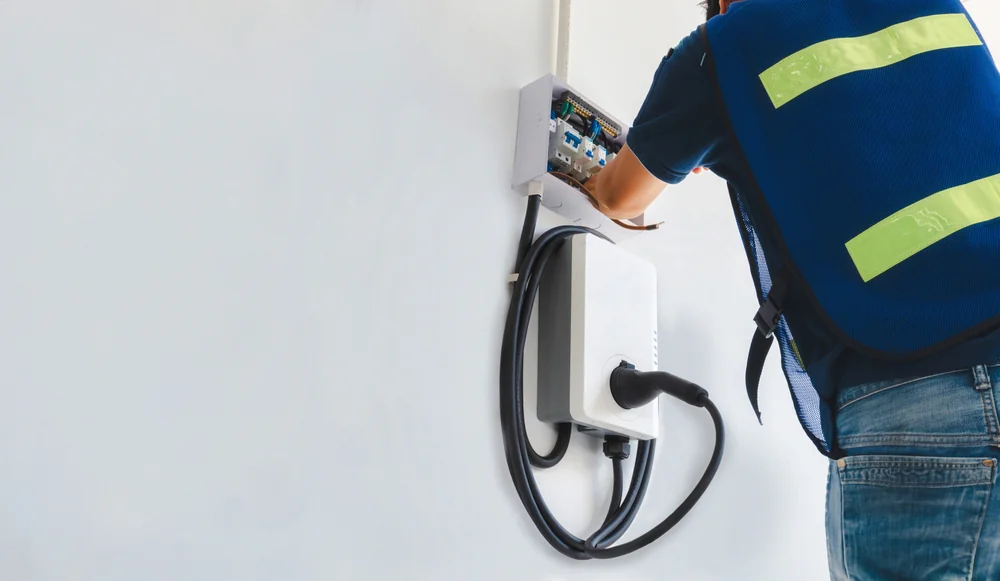
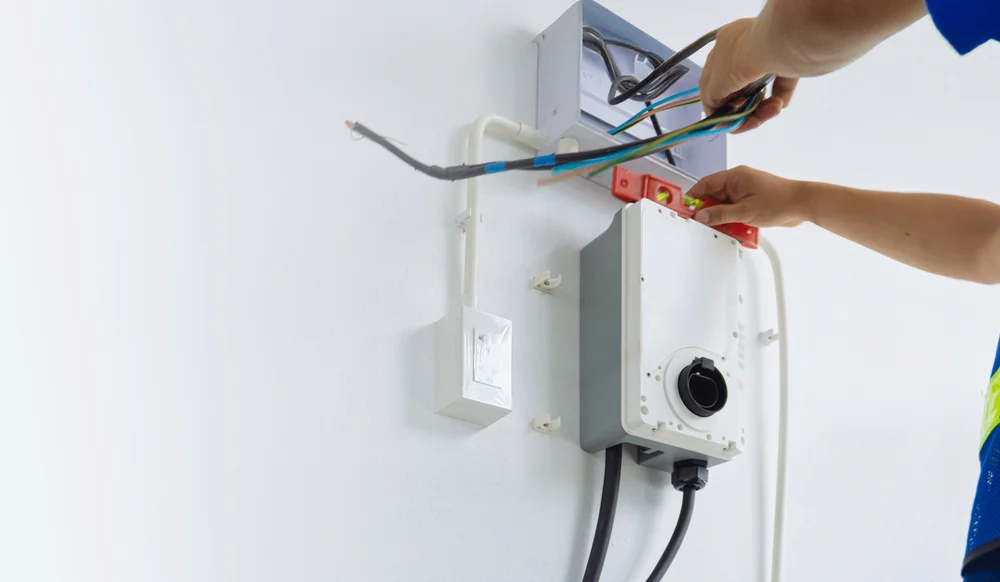
Electric Vehicle Charger Setup in Elon
You’re not dealing with crowded public charging stations or wondering if you’ll make it to the next stop. Your car charges overnight in your own driveway while you sleep.
A Level 2 EV charging station installed at your home means faster charging than a standard outlet, lower costs than public stations, and zero trips to wait in line. You control when and how your vehicle charges, and you’re not paying peak rates or dealing with broken equipment at a shopping center.
Your home’s electrical system gets evaluated before anything gets installed. That means no overloaded circuits, no tripped breakers, and no fire hazards from a charger pulling more power than your panel can handle. The setup includes proper permits, inspections, and Duke Energy rebate coordination so you’re not leaving money on the table or dealing with compliance issues later.
Elon's Licensed EV Charger Electricians
We’ve been serving Burlington, Graham, Mebane, Elon, and surrounding areas since 2002. Our company is led by a Master Electrician with over 35 years of electrical experience, and every job is handled by licensed, uniformed technicians who show up in fully stocked trucks.
Elon is home to a growing number of EV owners, especially around the university area where sustainability and technology adoption run high. But the local charging infrastructure hasn’t kept pace. With only nine public charging ports within 15 kilometers, most EV drivers here realize quickly that home charging isn’t optional—it’s essential.
We handle residential and commercial electrical work across the region, and EV charger installation has become a core part of what we do as North Carolina pushes toward 1.25 million electric vehicles on the road by 2030. If you’re in Elon and you drive an EV, you’re not experimenting with DIY wiring or hoping a general handyman gets it right.
How EV Charging Station Installation Works
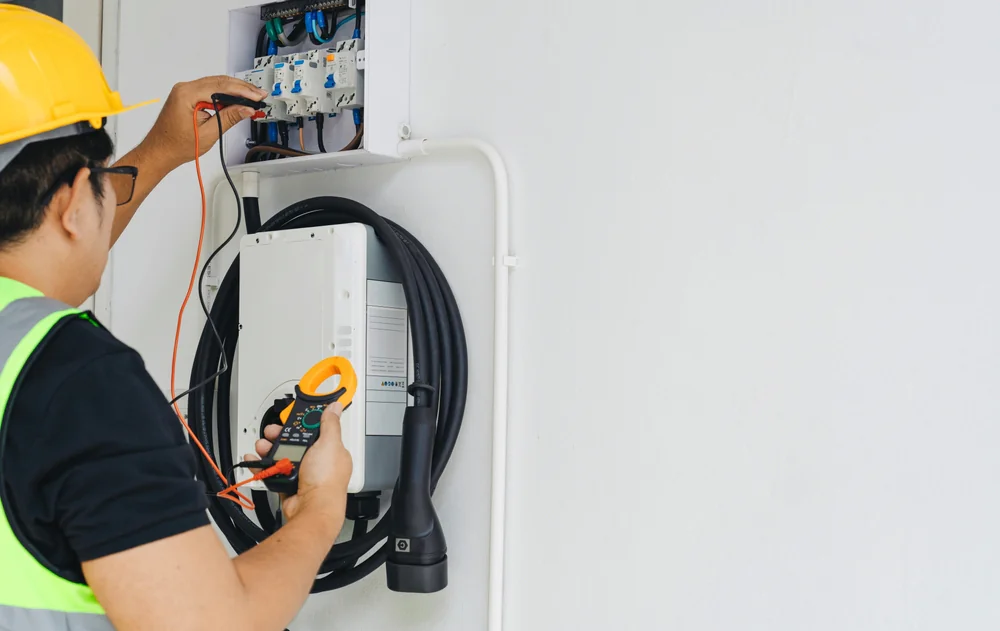
The process starts with an evaluation of your home’s electrical panel. A Level 2 charger typically requires a 240-volt circuit, and not every home is set up to handle that load without upgrades. We check your current capacity, determine what’s needed, and give you a flat-rate price before any work begins.
Once you approve the scope, we handle the permit applications with local authorities in Elon. Permits are required for this type of electrical work, and skipping that step can cause problems during home inspections or insurance claims down the road.
The installation itself involves running the appropriate wiring from your panel to the charger location—usually your garage or an exterior wall near where you park. The charger gets mounted, connected, and tested. After that, a local inspector verifies the work meets code.
If you’re eligible for Duke Energy’s EV Charger Installation Support Program, we help you navigate that process. The rebate can cover up to $1,117 in costs for outlets, wiring, panel upgrades, and related electrical improvements. That paperwork gets submitted after the install is complete and approved, and the credit comes back to you as a bill credit on your Duke Energy account.
What's Included in EV Charger Setup
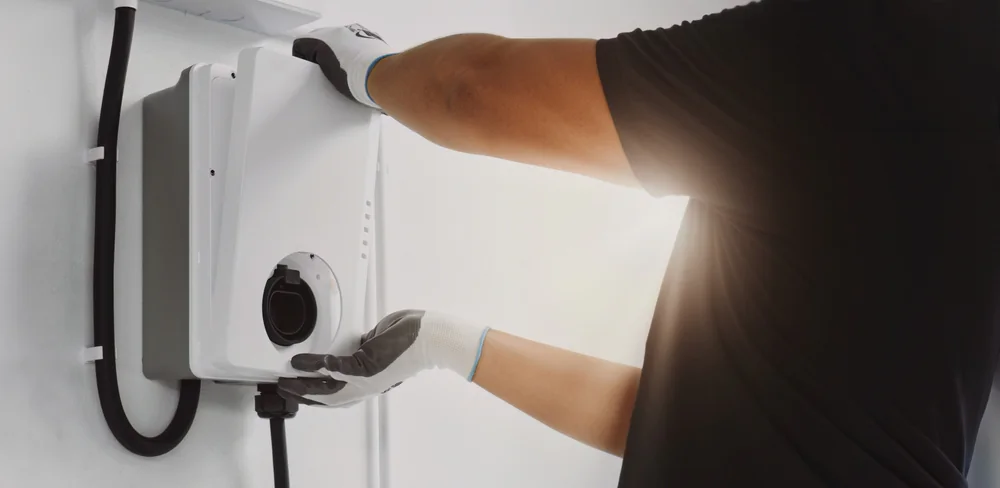
Your EV charger installation includes a full electrical assessment to determine if your current panel can support the load. If it can’t, we handle the panel upgrade or add a subpanel as needed. You’re not left guessing whether your system can handle it.
The service covers all necessary wiring from your electrical panel to the charger location, along with the installation of a dedicated 240-volt circuit. The charger itself gets mounted securely, whether that’s in your garage, on an exterior wall, or near your driveway.
Permit applications and inspections are part of the package. Elon requires permits for this type of work, and we coordinate with local authorities to make sure everything is filed, approved, and inspected properly. You’re not dealing with that process yourself.
If you want a smart charger with app integration, we can install models that let you monitor energy usage, schedule charging during off-peak hours, and control the system remotely. That’s especially useful if you’re on a time-of-use rate plan with Duke Energy, where charging overnight costs significantly less than charging during peak afternoon hours.
How much does it cost to install an EV charger at home in Elon?
Installation costs vary depending on your home’s current electrical setup and how far the charger is from your panel. If your electrical panel has available capacity and the charger location is close, you’re looking at the lower end of the range. If you need a panel upgrade, a subpanel, or extensive wiring run, costs go up.
Duke Energy offers a rebate program that covers up to $1,117 for EV charger installation costs, including outlets, wiring, and panel upgrades. That rebate comes as a credit on your Duke Energy bill after the work is completed and inspected. We handle the paperwork for that program, so you’re not navigating it alone.
The charger itself is a separate cost, and prices range depending on the brand and features. Basic Level 2 chargers start around a few hundred dollars, while smart chargers with app integration and scheduling features cost more. We provide flat-rate pricing after evaluating your home, so you know the total cost before work begins.
Do I need a permit to install an EV charger in Elon, NC?
Yes. Installing an EV charger requires electrical work that falls under local building codes, and Elon requires a permit for that type of installation. The permit ensures the work is done safely, meets code requirements, and gets inspected by local authorities.
Skipping the permit might seem like a shortcut, but it creates problems later. If you sell your home, unpermitted electrical work can come up during inspections and delay or kill the sale. If you ever file an insurance claim related to electrical issues, unpermitted work can give your insurer a reason to deny coverage.
We handle the permit application process as part of the installation. That includes submitting the necessary paperwork, coordinating with local inspectors, and making sure the work passes inspection. You’re not responsible for tracking down forms or scheduling inspections yourself.
Can my electrical panel handle an EV charger, or will I need an upgrade?
That depends on your current panel’s capacity and how much load it’s already supporting. Most Level 2 EV chargers require a 240-volt circuit with a 40- or 50-amp breaker. If your panel is older, already near capacity, or doesn’t have space for an additional breaker, you’ll need an upgrade or a subpanel.
Homes built in the last 20 years are more likely to have 200-amp panels with room for additional circuits. Older homes, especially those built before the 1990s, often have 100-amp panels that are already maxed out with HVAC, water heaters, and other appliances. Adding an EV charger to an overloaded panel creates a fire hazard and will trip breakers constantly.
We evaluate your panel before quoting the job. If an upgrade is needed, that gets included in the scope and the flat-rate price. Panel upgrades are also eligible for Duke Energy’s rebate program, so a portion of that cost can be covered by the credit.
How long does EV charger installation take from start to finish?
The actual installation work typically takes a few hours to a full day, depending on the complexity. If your panel has capacity and the charger location is straightforward, the job moves quickly. If a panel upgrade or long wiring run is involved, it takes longer.
The timeline also depends on permitting and inspection schedules. Once the permit is submitted, local authorities in Elon need to approve it before work begins. After installation, an inspector has to verify the work meets code. Those steps add time, but they’re required and non-negotiable.
From the day you schedule the job to the day your charger is operational and inspected, expect one to two weeks in most cases. We coordinate the permitting and inspection process to keep things moving, but some delays are outside anyone’s control depending on local government schedules.
What's the difference between Level 1 and Level 2 EV chargers?
Level 1 chargers plug into a standard 120-volt outlet—the same outlet you’d use for a lamp or phone charger. They’re slow, adding about 3 to 5 miles of range per hour of charging. If you drive 30 miles a day, you’re looking at 6 to 10 hours to recharge, which works for some people but not if you drive more or need a faster turnaround.
Level 2 chargers use a 240-volt circuit, the same voltage as your dryer or oven. They charge much faster—typically 20 to 30 miles of range per hour. That means a full charge overnight for most EVs, even if you’ve driven 50 or 60 miles that day. Level 2 is the standard for home installations because it’s fast enough to be practical without requiring the expensive infrastructure of DC fast chargers.
If you’re serious about driving an EV as your primary vehicle, Level 2 is the only setup that makes sense. Level 1 works as a backup or for very light driving, but it’s not a long-term solution for most households in Elon.
Will installing an EV charger increase my home's resale value?
It can, especially as EV adoption grows and more buyers expect charging infrastructure already in place. A professionally installed Level 2 charger signals that the home is updated, the electrical system can handle modern loads, and the buyer won’t have to deal with installation costs or permitting themselves.
In areas like Elon, where the university and surrounding community skew toward tech adoption and sustainability, an EV charger is increasingly seen as a desirable feature rather than a niche add-on. Buyers shopping for homes in 2025 and beyond are more likely to own or plan to own an EV, and a home with charging already set up has a clear advantage.
That said, the value boost depends on the local market and buyer pool. If most buyers in your area don’t drive EVs yet, the charger might not move the needle much. But as North Carolina pushes toward 1.25 million EVs on the road by 2030, that’s changing fast. Installing a charger now positions your home ahead of the curve.
Other Services we provide in Elon
About Us

Electrical Service Providers (ESP) has been in business since 2002. ESP started out performing wiring services to new construction, remodeling projects and residential homes. Our company’s president identified a market for electrical services to be performed in homes and businesses independent of new construction. Read More about Electrical Service Providers>>
All Rights Reserved.Organic Marketing LLC
Business Listings


Product Brands Used
Allied, Broan, Cutler Hammer, General Electric, Ideal, Juno, Kohler, Leviton, Lutron, Siemens, Square D
Contact
- Office Address: 3254 S Anthony Ct.
Burlington, NC 27215 - Mailing Address: PO Box 25
Alamance, NC 27201 - Phone: 336-228-3300
- E-mail: [email protected], [email protected]
Service Areas
Chapel Hill, Burlington, Carrboro, Durham, Gibsonville, Hillsborough, Graham, Pittsboro, Morrisville, Cary
About Us
Electrical Service Providers (ESP) has been in business since 2002. ESP started out performing wiring services to new construction, remodeling projects and residential homes. Our company’s president identified a market for electrical services to be performed in homes and businesses independent of new construction. Read More about Electrical Service Providers>>
All Rights Reserved.Organic Marketing LLC