EV Charger Installation in Hopedale, NC
Charge at Home Without the Guesswork
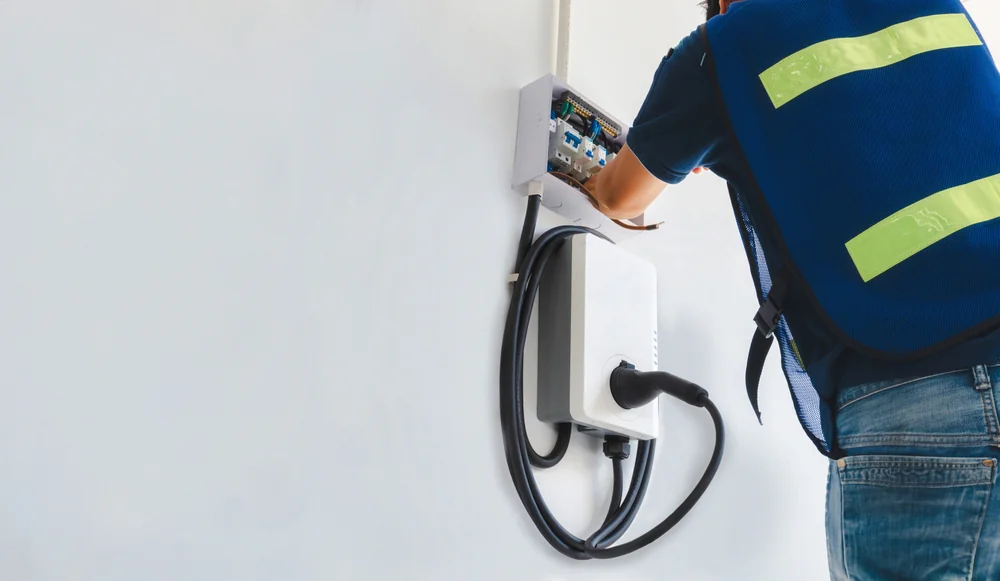
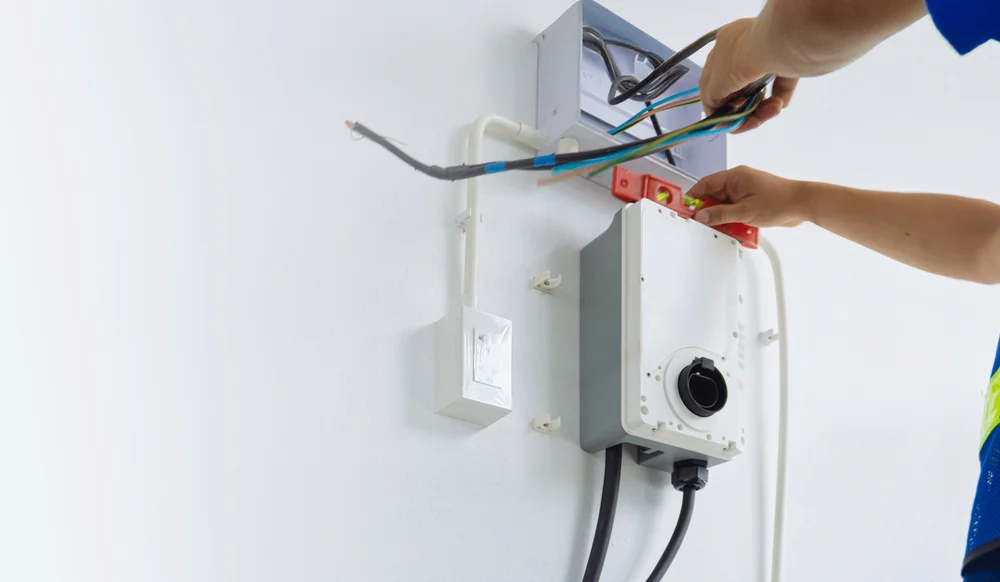
Home EV Charging Station Setup
You’re done circling public charging stations or planning your week around where you can plug in. A home EV charger means your car charges overnight while you sleep, and it’s ready when you are.
No more range anxiety. No more waiting in line at a charging station that’s either broken or occupied. You pull into your driveway, plug in, and forget about it.
And if you’re worried about what this does to your electric bill, here’s the reality: charging at home during off-peak hours costs significantly less per kilowatt-hour than public stations. Duke Energy even offers lower rates for EV owners who charge overnight. You’re not just gaining convenience—you’re actually spending less per mile than you would at a gas pump or public charger.
The right setup also future-proofs your home. Buyers in Alamance County and across the Triangle are specifically looking for homes with EV charging infrastructure already in place. It’s not a nice-to-have anymore. It’s expected.
Licensed Electricians Serving Hopedale, NC
ESP Electrical Service Providers has been handling residential electrical work in Hopedale, Burlington, Graham, and throughout Alamance County for over two decades. Our lead technician has held his electrical contractor license since 1989—that’s 35+ years of knowing what works, what doesn’t, and what’ll pass inspection the first time.
We’re not a national franchise with rotating crews. You’re working with the same locally owned team that’s been serving North Chatham, Orange, Durham, and Alamance counties since day one. We know the local inspectors, the permit process, and the quirks of older homes in this area.
When we say we’ll show up on time in a stocked truck and clean up before we leave, that’s not marketing talk. That’s how we’ve stayed in business this long in a town where word travels fast.
EV Charger Installation Process
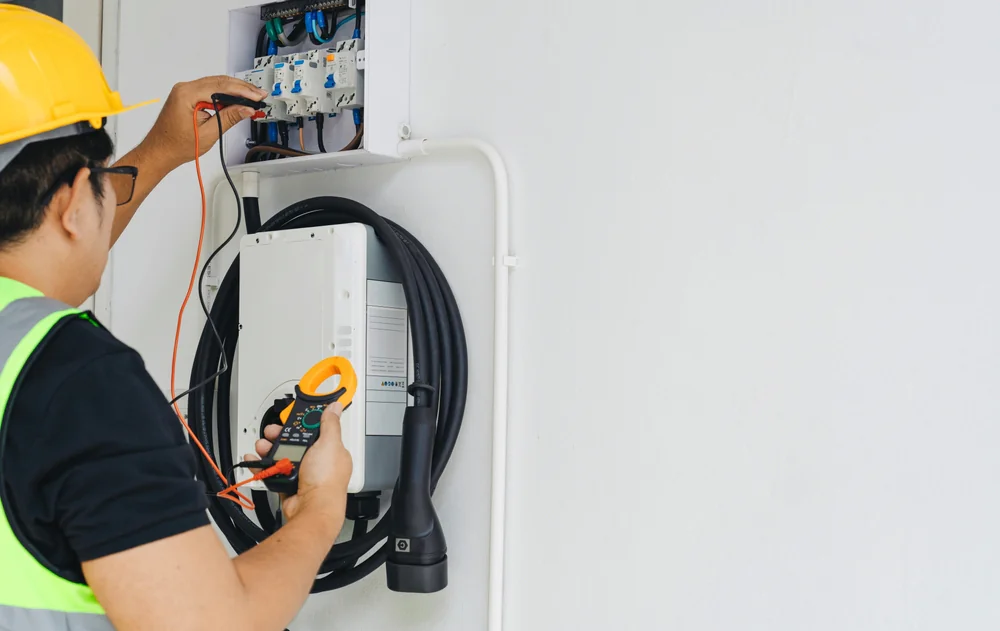
First, we assess your current electrical panel and the location where you want your EV charging station installed. Most homes in Hopedale were built before electric vehicles existed, so we need to confirm your panel can handle the load. If you’ve got 100-amp service and it’s already maxed out, we’ll talk through your options—including circuit sharing devices that can often eliminate the need for a full panel upgrade.
Next, we give you flat-rate pricing before any work starts. You’ll know exactly what this costs, including the charger itself, any necessary electrical upgrades, permit fees, and labor. No surprises, no hourly billing that spirals.
Then we handle the permit and schedule the installation. We pull the permits, coordinate the inspection, and make sure everything meets North Carolina electrical code. You don’t have to call the county or figure out what forms to file.
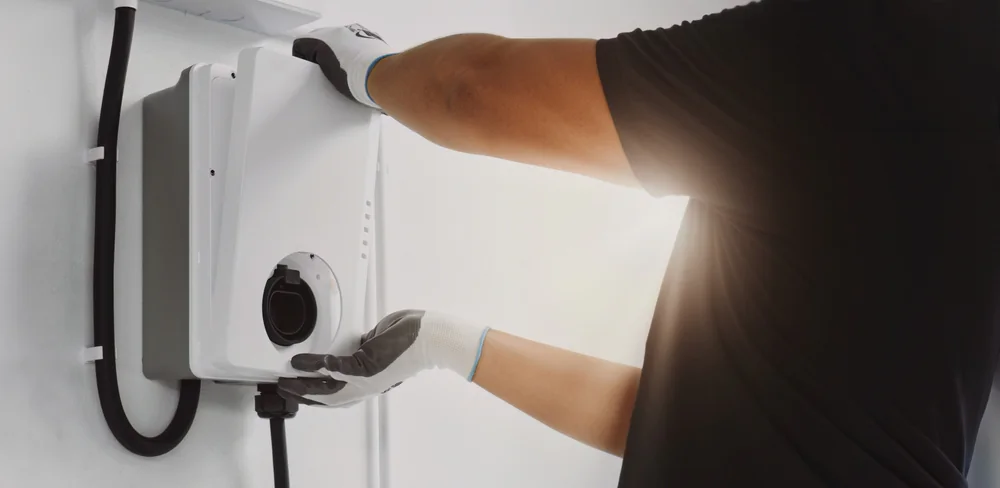
On installation day, we mount your Level 2 EV charger, run the appropriate wiring, connect it to your panel, and test the full system. We walk you through how it works, answer any questions about charging schedules or smart features, and clean up completely before we leave. The final step is the inspection sign-off, which we coordinate. Once that’s done, you’re charging at home.
Electric Vehicle Charger Installation Options
You’re getting a complete electric vehicle charger installation from licensed electricians who’ve done this enough times to spot problems before they become expensive. That includes a full electrical assessment, load calculation, and honest conversation about whether your current panel can support a Level 2 charger or if you need an upgrade.
We install all major EV charger brands and can work with whatever unit you’ve already purchased—or help you choose one that fits your vehicle and budget. Most of our residential customers in Hopedale and Burlington go with Level 2 chargers because they fully charge overnight and don’t require the expensive infrastructure that DC fast chargers need.
If your home needs an electrical panel upgrade, we handle that too. We’re not just plugging in a charger and hoping your system holds up. We’re making sure your home’s electrical capacity supports this addition safely and efficiently.
Here’s what matters to most people: we also help you navigate the rebate process. Duke Energy is currently offering up to $1,117 per household for EV charging infrastructure, and there’s a federal tax credit worth up to $1,000 for residential installations. We’ll make sure you have the documentation you need to claim both. That can cover a significant portion of your total installation cost, but only if it’s done right and submitted correctly.
How much does it cost to install an EV charger at my home in Hopedale?
The honest answer is it depends on your current electrical setup. If your panel has available capacity and the charger location is close to your panel, you’re looking at a simpler installation. If you need a panel upgrade or a long wire run from your panel to your garage, the cost goes up.
Most residential Level 2 EV charger installations in Alamance County range from $1,200 to $3,500 depending on those variables. Panel upgrades add anywhere from $1,500 to $4,000, depending on your home’s current service and local permit fees.
But here’s what offsets that: Duke Energy’s rebate covers up to $1,117 of your installation costs, and the federal tax credit adds another $1,000. Between those two programs, you could be looking at over $2,000 back. We give you flat-rate pricing upfront so you know your total cost before we start, and we provide the documentation you need to claim every dollar you’re entitled to.
Do I need to upgrade my electrical panel to install an EV charger?
Not always, but it’s common in older homes. Most Level 2 EV chargers pull 40 to 50 amps, and if your home has 100-amp service that’s already running your HVAC, water heater, and everything else, there’s not much room left.
The good news is there are options. Circuit sharing devices can reduce the need for a panel upgrade by about 60% in homes with 100-amp service. These devices intelligently manage the load so your charger and other high-draw appliances don’t run at full capacity simultaneously.
We’ll do a load calculation during the assessment and tell you exactly what your home can handle. If an upgrade makes sense, we’ll explain why and what it costs. If we can avoid it with a sharing device or load management, we’ll do that instead. The goal is to get you charging safely and legally without spending more than necessary.
How long does EV charger installation take?
If your electrical panel is ready and doesn’t need an upgrade, most installations take four to six hours. That includes mounting the charger, running the wiring, connecting everything to your panel, and testing the system.
If you need a panel upgrade, add another day for that work. Then there’s the inspection, which we schedule after installation. Alamance County inspections usually happen within a few days of the request, but timing can vary.
From the day you call us to the day you’re charging at home, expect about one to two weeks if no panel upgrade is needed. With an upgrade, it’s closer to two to three weeks. We’ll give you a realistic timeline upfront and keep you updated if anything changes.
Can you help me get the Duke Energy rebate for EV charger installation?
Yes. Duke Energy offers up to $1,117 per household for EV charging infrastructure, and that includes the costs of installing outlets, upgrading wiring, panel upgrades, and other electrical work required for home charging.
The rebate requires specific documentation—proof of purchase, proof of installation by a licensed electrician, and sometimes photos or inspection records. We provide all of that as part of our service.
Here’s what trips people up: the rebate has to be claimed within a certain timeframe, and the work has to meet Duke Energy’s requirements. If you use an unlicensed contractor or don’t submit the right paperwork, you lose that money. We’ve done this enough times to know exactly what Duke Energy needs, and we make sure you get it. That rebate combined with the federal tax credit can cut your out-of-pocket cost nearly in half.
What's the difference between Level 1 and Level 2 EV chargers?
Level 1 chargers plug into a standard 120-volt outlet—the same outlet you’d use for a lamp. They’re slow. You’re looking at about 3 to 5 miles of range per hour of charging. If you drive 40 miles a day, you’ll need 8 to 12 hours to recharge overnight. It works if you drive very little, but most people find it frustrating.
Level 2 chargers run on 240 volts, the same as your dryer or oven. They charge much faster—typically 25 to 30 miles of range per hour. That means a full charge overnight, even if you’ve drained the battery. For most EV owners in Hopedale and the surrounding area, Level 2 is the practical choice.
Level 2 chargers require professional installation because they need a dedicated 240-volt circuit and proper load management. You can’t just plug them into an existing outlet. That’s where we come in. We size the circuit correctly, install the charger to code, and make sure your system is safe and efficient.
Will installing an EV charger increase my home's value?
It’s increasingly expected, especially in areas like the Research Triangle and Alamance County where EV adoption is growing fast. North Carolina added 50,000 EVs in just two years, and buyers looking at homes now are specifically asking whether there’s charging infrastructure in place.
Real estate agents in Burlington, Chapel Hill, and Durham are reporting that homes with EV chargers installed are easier to sell and often command slightly higher offers, particularly in the $300K+ range where EV ownership is more common. It’s similar to how solar panels or smart thermostats add appeal—it signals that the home is updated and ready for modern needs.
Even if you’re not selling anytime soon, you’re making your home more competitive when you do. And in the meantime, you’re saving money on fuel and gaining the convenience of charging at home. The installation pays for itself in practicality long before you ever list the house.
Other Services we provide in Hopedale
About Us

Electrical Service Providers (ESP) has been in business since 2002. ESP started out performing wiring services to new construction, remodeling projects and residential homes. Our company’s president identified a market for electrical services to be performed in homes and businesses independent of new construction. Read More about Electrical Service Providers>>
All Rights Reserved.Organic Marketing LLC
Business Listings


Product Brands Used
Allied, Broan, Cutler Hammer, General Electric, Ideal, Juno, Kohler, Leviton, Lutron, Siemens, Square D
Contact
- Office Address: 3254 S Anthony Ct.
Burlington, NC 27215 - Mailing Address: PO Box 25
Alamance, NC 27201 - Phone: 336-228-3300
- E-mail: [email protected], [email protected]
Service Areas
Chapel Hill, Burlington, Carrboro, Durham, Gibsonville, Hillsborough, Graham, Pittsboro, Morrisville, Cary
About Us
Electrical Service Providers (ESP) has been in business since 2002. ESP started out performing wiring services to new construction, remodeling projects and residential homes. Our company’s president identified a market for electrical services to be performed in homes and businesses independent of new construction. Read More about Electrical Service Providers>>
All Rights Reserved.Organic Marketing LLC