EV Charger Installation in Summerfield, NC
Charge at Home Without the Fire Risk
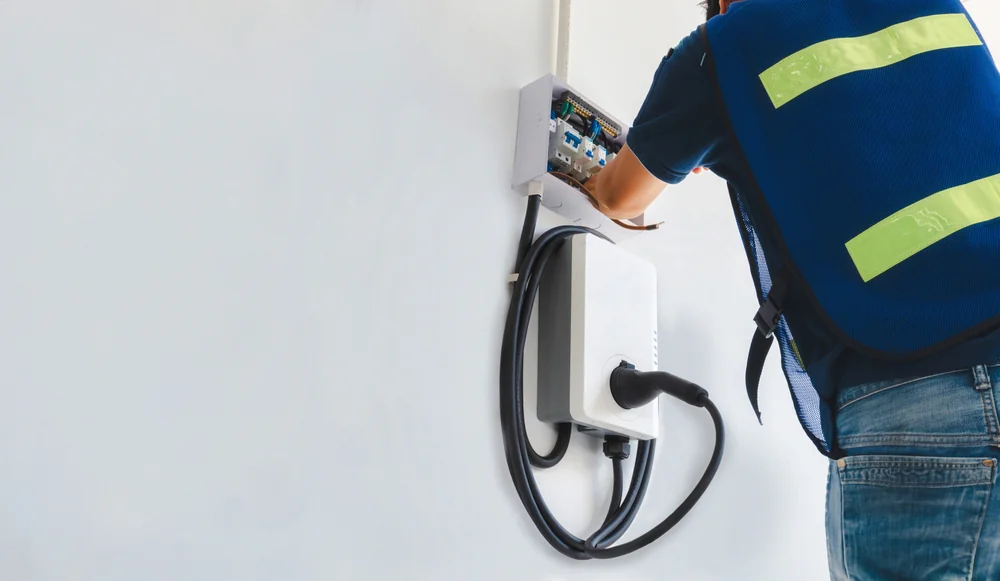
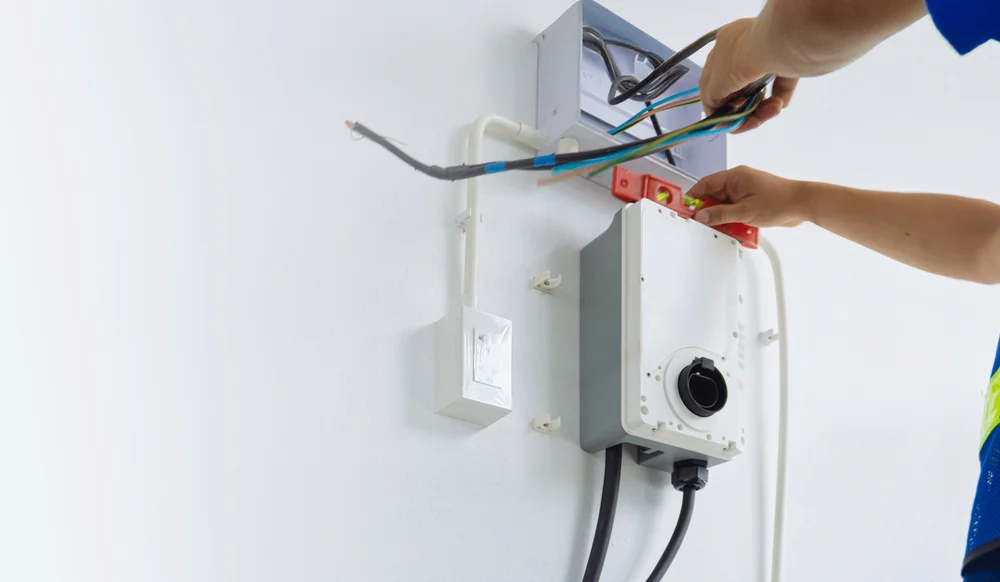
Electric Vehicle Charger Setup in Summerfield
You bought an EV to simplify your life, not to plan your week around public charging stations. A proper home charging setup means you leave every morning with a full battery, no detours, no waiting in line at overcrowded stations.
Your car charges while you sleep, using off-peak electricity rates that cost a fraction of what you’d pay at commercial stations. Most Summerfield homeowners save $800 to $1,200 annually compared to relying on public charging infrastructure.
Duke Energy currently offers up to $1,117 in rebates for Level 2 EV charger installation, and the federal tax credit adds another $1,000. That’s real money back in your pocket, but only if the installation meets their requirements. We handle the paperwork, the permits through Guilford County, and the installation to code so you actually get those rebates.
Your home’s value increases too. Recent data shows homes with installed EV chargers sell faster and command higher prices, especially in communities like Summerfield where EV adoption is accelerating.
Licensed EV Charger Installers Serving Summerfield
We’ve served Summerfield and Guilford County for over two decades. We’re not a national franchise following a script. We’re a locally owned electrical contractor led by Andy Helton, a Master Electrician with 35 years of hands-on experience.
We’ve watched Summerfield grow from a quiet community into one of the area’s most desirable neighborhoods. We know the housing stock here, the electrical infrastructure, and what it takes to get permits approved quickly through local inspectors.
You’ll talk directly to us, not a call center. Our trucks are fully stocked, our technicians are uniformed and licensed, and we clean up when we’re done. We’ve built our reputation on showing up when we say we will and doing the work right the first time.
Our EV Charging Station Installation Process
First, we assess your electrical panel and calculate your home’s load capacity. Most EV chargers need a 240-volt circuit with 40 to 50 amps of dedicated power. If your panel can handle it, great. If not, we’ll discuss a panel upgrade before moving forward.
Next, we determine the best location for your charger based on where you park, the distance from your panel, and local code requirements. We measure the wire run, identify any obstacles, and give you a flat-rate price before any work begins.
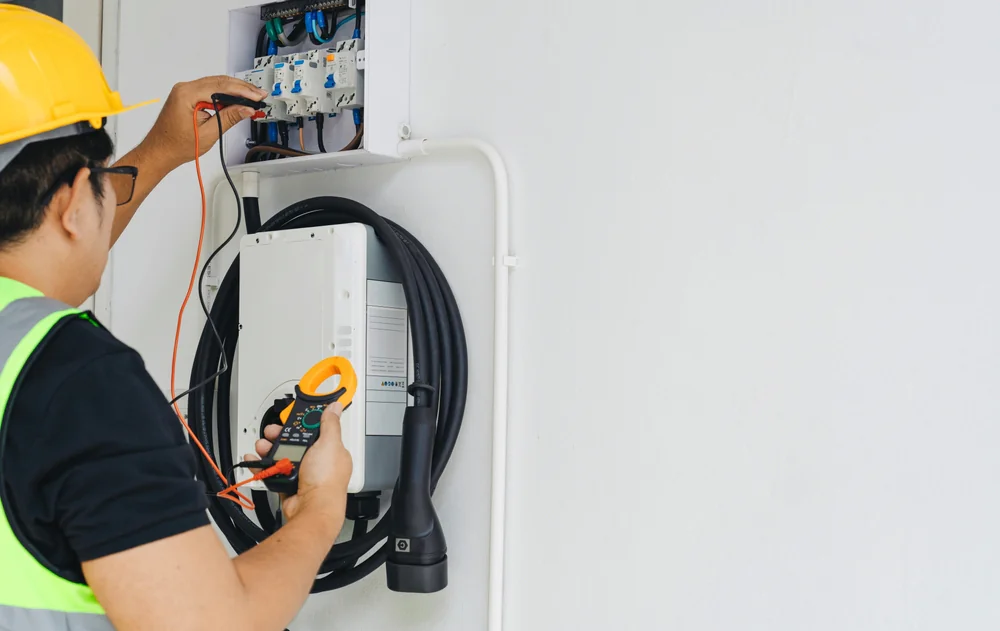
Once you approve, we pull the necessary permits through Guilford County and schedule the installation. Our electrician runs the dedicated circuit, mounts your charger, and connects everything according to National Electrical Code standards. We test the system to make sure it’s delivering the right voltage and amperage.
Finally, we schedule the inspection, walk you through how to use your new charger, and submit your rebate documentation to Duke Energy. You get copies of everything: permits, inspection certificates, and warranty information. The whole process typically takes one to two weeks from assessment to final inspection.

What's Included in Our EV Charger Installation
Every installation includes a complete electrical assessment of your main panel and load calculation. We’re checking whether your existing service can support the additional demand or if you need an upgrade to 150 or 200 amps.
We handle all permit applications and coordinate inspections with Guilford County. You don’t make phone calls or stand in line at the permit office. We know what inspectors look for and we install to pass the first time.
Your installation includes the dedicated 240-volt circuit, proper wire sizing for the distance, a disconnect if required by code, and professional mounting of your charger. We work with all major brands: Tesla Wall Connectors, ChargePoint, JuiceBox, Grizzl-E, and others.
Summerfield’s housing stock is predominantly single-family homes built in the last 20 years, but electrical systems vary widely. Some homes have panels in garages, others in basements or exterior walls. We adapt our installation approach to your specific situation, not a one-size-fits-all template.
We also coordinate your Duke Energy rebate application. Their EV Charger Installation Support Program requires specific documentation and proof of compliance. We’ve done this enough times to know exactly what they need, which speeds up your reimbursement significantly.
How much does EV charger installation cost in Summerfield, NC?
Installation costs typically range from $800 to $2,500 depending on the distance from your electrical panel to your parking area and whether you need a panel upgrade. A straightforward installation in a garage with an existing 200-amp service and a short wire run costs less than running a circuit 75 feet to a detached carport.
Panel upgrades add $1,500 to $3,000 if your home currently has 100-amp service, which isn’t uncommon in older Summerfield properties. The upgrade isn’t just for your EV charger—it increases your home’s overall electrical capacity and is often necessary to meet current code requirements.
Duke Energy’s rebate covers up to $1,117 of your installation cost, and the federal tax credit adds up to $1,000. Between those two programs, many homeowners recover half or more of their total installation expense. We give you a flat-rate quote upfront so you know your out-of-pocket cost before we start work.
Can I just plug my EV into a regular outlet?
You can, but you shouldn’t make it a habit. Standard 120-volt outlets deliver about 3 to 5 miles of range per hour of charging. If you drive 40 miles a day, you’re looking at 8 to 12 hours to recharge, and that’s assuming nothing else is drawing power on that circuit.
The bigger issue is safety. Regular outlets aren’t designed for sustained high-amperage loads. Charging an EV for hours every night heats up the wiring, connections, and outlet itself. That heat degrades components over time and creates fire risk. We’ve seen melted outlets, scorched wall plates, and breakers that trip repeatedly.
A Level 2 charger on a dedicated 240-volt circuit delivers 25 to 30 miles of range per hour and doesn’t stress your electrical system. It’s designed for the job. Your EV manufacturer recommends it, your insurance company expects it, and your home’s wiring will last longer because of it.
Do I need a permit for EV charger installation?
Yes. Guilford County requires an electrical permit for any new 240-volt circuit installation, which includes EV chargers. The permit process ensures your installation meets National Electrical Code standards and local amendments.
Some homeowners try to skip the permit to save money or time, but that creates problems down the road. If you ever sell your home, unpermitted electrical work shows up during inspections and can kill a sale or force you to rip everything out and redo it properly. Your homeowner’s insurance may also deny claims related to unpermitted work.
We pull permits for every installation because it protects you legally and financially. The permit costs $75 to $150 depending on the scope of work, and the inspection typically happens within a few days of completion. It’s a small investment for significant peace of mind and full compliance with local regulations.
Will my electrical panel need to be upgraded?
It depends on your current service capacity and what else is running in your home. Most Level 2 EV chargers require a 40 to 50-amp dedicated circuit. If you have a 200-amp panel with available breaker slots and your total load calculation stays within limits, you’re probably fine.
Homes with 100-amp service almost always need an upgrade. You’re running HVAC, water heater, kitchen appliances, and everything else on that 100 amps. Adding a 40-amp EV charger pushes you over safe capacity, especially during peak usage times.
We perform a complete load calculation during our assessment. We add up your existing circuits, factor in your EV charger, and determine whether your service can handle it. If an upgrade is necessary, we’ll explain why and give you a clear price. Many Summerfield homes built before 2000 have 100 or 150-amp service, so upgrades are common but not universal.
How long does EV charger installation take?
The actual installation work takes four to eight hours depending on wire run length and complexity. If we’re mounting a charger in your garage with the panel 20 feet away and no obstacles, we’re done in half a day. Running wire through finished walls, across attics, or to a detached structure takes longer.
The full timeline from assessment to final inspection is typically one to two weeks. That includes scheduling our initial visit, ordering your charger if you don’t have one yet, pulling permits, completing the installation, and coordinating the county inspection.
Permit approval usually takes two to three business days in Guilford County. Inspections are scheduled within a few days of completion. We stay on top of the process so you’re not waiting around wondering what’s happening next. You’ll know the schedule upfront and we’ll update you if anything changes.
What EV chargers do you recommend for Summerfield homes?
We install whatever charger you prefer, but we typically recommend ChargePoint Home Flex, JuiceBox 40, or Grizzl-E for non-Tesla vehicles. These units are reliable, offer smartphone connectivity, and qualify for Duke Energy rebates. They work with every major EV brand and deliver 32 to 40 amps of charging power.
For Tesla owners, the Tesla Wall Connector is the obvious choice. It’s designed specifically for Tesla vehicles, integrates with your car’s software, and delivers up to 48 amps. It’s also one of the most affordable options at around $400 to $500 for the unit itself.
Smart chargers with WiFi connectivity let you schedule charging during off-peak hours when electricity rates are lowest, track your energy usage, and receive notifications when charging is complete. That functionality is worth the extra $100 to $200 for most homeowners. We’ll discuss your specific vehicle, your parking situation, and your budget during the assessment and recommend what makes sense for your setup.
Other Services we provide in Summerfield
About Us

Electrical Service Providers (ESP) has been in business since 2002. ESP started out performing wiring services to new construction, remodeling projects and residential homes. Our company’s president identified a market for electrical services to be performed in homes and businesses independent of new construction. Read More about Electrical Service Providers>>
All Rights Reserved.Organic Marketing LLC
Business Listings


Product Brands Used
Allied, Broan, Cutler Hammer, General Electric, Ideal, Juno, Kohler, Leviton, Lutron, Siemens, Square D
Contact
- Office Address: 3254 S Anthony Ct.
Burlington, NC 27215 - Mailing Address: PO Box 25
Alamance, NC 27201 - Phone: 336-228-3300
- E-mail: [email protected], [email protected]
Service Areas
Chapel Hill, Burlington, Carrboro, Durham, Gibsonville, Hillsborough, Graham, Pittsboro, Morrisville, Cary
About Us
Electrical Service Providers (ESP) has been in business since 2002. ESP started out performing wiring services to new construction, remodeling projects and residential homes. Our company’s president identified a market for electrical services to be performed in homes and businesses independent of new construction. Read More about Electrical Service Providers>>
All Rights Reserved.Organic Marketing LLC