Most Alamance County homeowners don't think about their generator until the power's already out. Here's why fall is the window that actually matters.
Share:
Summary:
If your generator ran its weekly exercise cycle all summer without tripping a fault, it’s easy to assume everything’s fine. But that 12-minute self-test doesn’t check your oil condition, your battery capacity, your cooling system, or whether the transfer switch will hold under a real load. It just confirms the engine starts. Here in Alamance County, fall is the one window each year when you’re not already in the middle of a storm — and not yet staring down another one. That window is shorter than most people think, and what you do with it determines whether your generator actually works when you need it.
A lot of homeowners picture a generator tune-up as a quick oil change and a visual once-over. In reality, a proper annual service for a whole home standby generator is a full system inspection — engine, electrical, fuel, cooling, and transfer switch all included. Each of those systems has its own failure modes, and skipping any one of them is how a generator that “ran fine last year” fails during a three-day outage in January.
The goal isn’t just to keep the engine running. It’s to confirm that every component in the system will perform under actual load, for an extended period, without failing. That’s a meaningfully different standard than passing a weekly self-test.
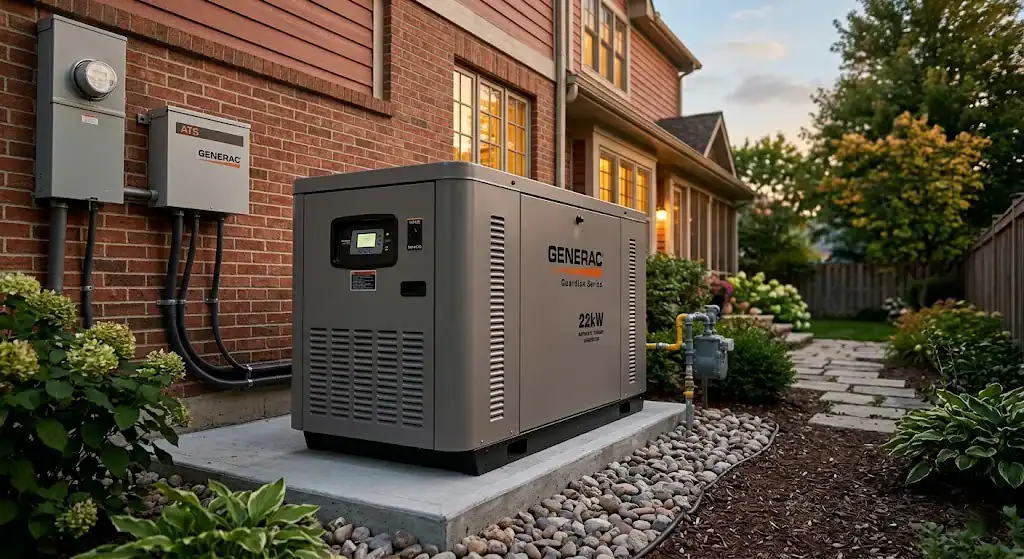
A thorough tune-up covers the things the self-test can’t. Engine oil is the most obvious one — it degrades on a calendar schedule, not just an hours schedule, which means a lightly used generator still needs fresh oil after 12 months. Air and fuel filters get checked and replaced as needed. The spark plugs, belts, and coolant levels are all inspected. The battery gets tested for actual capacity, not just whether it holds a surface charge. If it’s been five years since the battery was replaced, it gets swapped — because a dead battery at 11 p.m. during an ice storm is exactly the kind of failure that turns into an emergency service call.
The transfer switch is one of the most overlooked components in the whole system. It’s the mechanism that detects an outage and switches your home from utility power to generator power — automatically, within seconds. A generator with a clean engine and a failing transfer switch will still leave your house dark. A real tune-up tests the transfer switch under load, not just in the self-test cycle.
Fuel system integrity is the third leg of the inspection. Industry data puts fuel, cooling, and electrical system failures at roughly 90% of all generator failures combined. Those are exactly the systems that accumulate wear over a summer of heat and humidity — and exactly the systems a professional tune-up is designed to catch before they fail.
Here’s something worth knowing: most manufacturer warranties require documented proof of regular maintenance. If you skip the annual service and the unit fails, you may be looking at a repair or replacement bill that the warranty would have covered — had the service record been there to support the claim. Replacement cost for a whole home standby generator runs $7,000 to $15,000. Annual professional service typically runs $300 to $600. The math is straightforward.
Some of it, yes. Keeping debris cleared from around the unit, making sure it’s set to AUTO mode, and doing a visual check for oil leaks or corrosion are all things a homeowner can and should do. Those basic checks take five minutes and catch obvious problems early.
The annual service itself is a different matter. Testing battery capacity requires equipment most homeowners don’t have. Load bank testing — running the generator under a simulated full load to confirm it can sustain output — isn’t something you can replicate by flipping breakers. Inspecting the transfer switch for wear and verifying it operates correctly under load requires both the tools and the training to know what you’re looking at. And documenting the service in a format that satisfies your manufacturer’s warranty requirements means following their specific inspection protocol, not just noting that you changed the oil.
There’s also the brand-specific knowledge factor. Generac, Kohler, and Briggs & Stratton all have their own service requirements, their own common failure points, and their own documentation standards. A technician who has serviced dozens of each model knows what to look for in ways that a general inspection simply doesn’t replicate.
If something turns up during the inspection — a worn belt, a battery that’s borderline, a fuel line showing early signs of deterioration — we can handle it the same day with a fully stocked truck. No second appointment, no waiting on parts.
Want live answers?
Connect with a Electrical Service Providers expert for fast, friendly support.
Most generator maintenance content talks about “before storm season” or “before winter” as if those are two separate considerations. In Alamance County, they’re not. The Atlantic hurricane season runs through November 30. The NC Piedmont’s ice storm season starts in December. Fall is the gap between them — and it’s a narrow one.
That overlap isn’t theoretical. Tropical Storm Chantal pushed the Haw River to 32.5 feet in Alamance County — four inches from the all-time record set by Hurricane Fran in 1996. The Burlington airport recorded its highest single-day rainfall total since 2001. Saxapahaw’s Buddy Collins Memorial Bridge was completely submerged, and the village was cut off for days. That happened in 2026. Hurricane Helene hit North Carolina in 2024 and caused $59.6 billion in damage — the costliest storm in NC history.

By the time September arrives, your generator has just come through the most stressful season it faces. NC summers are hard on standby units in ways that don’t show up in the self-test log. Heat accelerates oil breakdown. Humidity corrodes battery terminals and electrical connections. Cooling systems work harder in sustained high temperatures, and that wear accumulates over months — not in a single dramatic failure, but gradually, quietly, until something gives.
The weekly exercise cycle runs the engine for roughly 12 minutes. That’s enough to keep the cylinders lubricated and the battery from going completely flat. It is not enough to reveal that the oil is past its useful life, that the battery is holding 60% of its rated capacity, or that the coolant level has dropped. Those are the conditions a fall tune-up is designed to find — before the first hard freeze makes them matter.
There’s also a scheduling reality worth understanding. After a significant storm event, generator service companies across the Carolinas are booked out for weeks. Homeowners who waited get put on a list. The ones who scheduled in October are already covered. Fall service isn’t just about catching summer wear — it’s about getting your appointment before the window closes and the waitlist opens.
Fuel source is one of the most practical considerations for standby generator owners in Alamance County, and it varies significantly depending on where you live. Piedmont Natural Gas serves most of Burlington’s urban core, which means homeowners in those areas can connect a standby generator directly to the utility line. That’s an underground fuel supply that storm damage can’t interrupt — no tank to refill, no running out mid-outage. For a generator that might run for three or four days straight during a major weather event, that’s a meaningful advantage.
In the more rural parts of western Alamance County — Snow Camp, Saxapahaw, Swepsonville — natural gas service isn’t available, and propane is the practical alternative. Many homeowners in those areas already have tanks on-site for heating or cooking, and a standby generator can be configured to run from the same supply. The key consideration is tank size: a whole home generator running continuously through a multi-day outage will consume propane at a rate that a small tank won’t sustain. Getting the fuel logistics right before an outage — not during one — is part of what proper installation and annual service should address.
This is the kind of local detail that matters when you’re working with someone who actually knows Alamance County. The fuel infrastructure in Burlington is different from the fuel infrastructure in Saxapahaw, and a generator service provider who treats every installation the same way isn’t accounting for that difference. It affects how the system is configured, how it’s maintained, and how it performs when you need it most.
The honest answer is: before you need it. Fall — specifically September through November — is the practical window for Alamance County homeowners. Hurricane season is winding down, winter hasn’t started, and appointment availability is still reasonable. That combination doesn’t last long.
Annual professional service for a standby generator runs $300 to $600. It covers everything the self-test doesn’t: oil, filters, battery, cooling system, fuel system, transfer switch, and load test. It keeps your warranty valid and your generator ready for whatever the next several months bring.
If you’re not sure when your generator was last serviced — or if it’s been more than a year — that’s the answer. We’ve been servicing whole home generators across Alamance County since 2002. Give us a call at (336) 228-3300 and a real person will pick up.
Article details:
Share:
Continue learning: