Not all standby generators — or installers — are created equal. Here's what homeowners across Alamance, Durham, Orange, Chatham, and Guilford County should know before choosing Kohler backup power.
Share:

Summary:
Most homeowners start thinking seriously about a standby generator right after a storm — when the power’s been out for two days, the refrigerator is warm, and the well pump isn’t working. That moment has a way of making the decision feel urgent. But urgency without information leads to rushed choices, and a standby generator is not a small purchase.
If you’ve landed here, you’re probably past the “should I get a generator” question and into the “which one, and who installs it” territory. That’s a better question. Let’s work through it honestly — starting with what actually sets Kohler apart, and what you need to know before signing anything.
Kohler has been building generators since 1920. That’s not a marketing footnote — it’s over a century of engineering refinement that shows up in how their residential standby units are built and how they perform under real conditions.
Where Kohler separates itself most clearly is in power quality and load handling. Their generators use a skewed, rotating field alternator design that produces exceptionally clean, stable power — the kind that matters when you’re running sensitive electronics, a home office setup, or medical equipment that doesn’t tolerate fluctuations. That’s not a feature every generator on the market can claim.
Here’s the scenario most homeowners don’t think about until it’s too late: the power goes out, your standby generator kicks on, and within seconds your central air conditioner, refrigerator, sump pump, and well pump all try to start at the same time. Each of those appliances draws a significant surge of power at startup — far more than they need once they’re running. That simultaneous surge is where a lot of generators struggle, and where some fail to hold the load.
Kohler’s PowerBoost Technology is designed specifically for this moment. It allows the generator to absorb and manage those heavy startup loads without dropping power to the rest of the house. For a homeowner in rural Chatham County running on well water, or a Chapel Hill household with central AC and a finished basement, this isn’t a theoretical advantage — it’s the difference between whole-home coverage and a generator that can only handle part of the load.
This matters even more in our service area than it might in a dense urban market. A significant portion of homes across Alamance, Orange, and Chatham Counties rely on private wells. No power means no water — not just for comfort, but for basic sanitation. A generator that can’t reliably start a well pump under load is a generator that’s failing at one of its most important jobs.
PowerBoost is exclusive to Kohler. You won’t find it in a Generac unit or most other residential standby brands. It’s one of the clearest technical reasons the Kohler premium exists — and one of the clearest reasons it’s often justified.
Kohler also promotes industry-leading return-to-power speed. When your utility power drops, the automatic transfer switch detects the outage, signals the generator to start, and switches your home’s power source — all without you doing anything. Kohler’s engineering is designed to make that transition faster than competing brands, which means less of a gap between the outage and your home being fully powered.
This is the question we hear most often, and it deserves a straight answer rather than a sales pitch. Kohler generators typically cost more than comparable Generac models — the gap in North Carolina tends to run in the range of 15 to 25 percent depending on the unit and configuration. That’s real money, and it’s a fair thing to weigh.
What you’re paying for is a combination of build quality, power output stability, load management capability, and quieter operation. Kohler’s residential standby generators use commercial-grade engines — the same engineering heritage that powers backup systems in hospitals, data centers, and critical infrastructure. For most homeowners, that level of durability is more than they’ll ever need. For others — particularly those running medical equipment, home-based businesses, or high-end electronics — it’s exactly what they need.
The quiet operation point is worth mentioning for homeowners in suburban Durham, Greensboro, or Chapel Hill neighborhoods with HOA restrictions or close neighbors. Kohler generators are engineered to run significantly quieter than many competing units, which makes them a practical fit for neighborhoods where noise is a real consideration.
We sell and install both Kohler and Generac, and we’re not going to tell you Kohler is the right choice for every home. What we can tell you is that for homes with high whole-house load requirements, medical equipment dependencies, or homeowners who simply want the most reliable, longest-lasting unit available, Kohler is consistently the better answer. The conversation about which brand fits your specific situation is one we’re glad to have — without pressure in either direction.
One thing that doesn’t get discussed enough in these comparisons: the installer matters as much as the brand. A Kohler generator installed incorrectly, undersized for your actual load, or connected without proper permits is a liability regardless of how good the equipment is. We’ll come back to that.
Want live answers?
Connect with a Electrical Service Providers expert for fast, friendly support.
We are an Authorized Kohler Dealer — and that phrase carries more weight than it might appear to at first glance. It doesn’t just mean we sell Kohler units. It means our technicians are factory-trained by Kohler, we use genuine OEM parts, and we can honor Kohler’s manufacturer warranty on every installation we perform.
That last point is the one most homeowners miss. If a generator is installed by someone who isn’t an authorized Kohler dealer, the manufacturer warranty on that unit may be voided — and the homeowner often doesn’t find out until something goes wrong and they file a claim. A $10,000+ system with no warranty coverage is a very different purchase than one that’s fully backed.
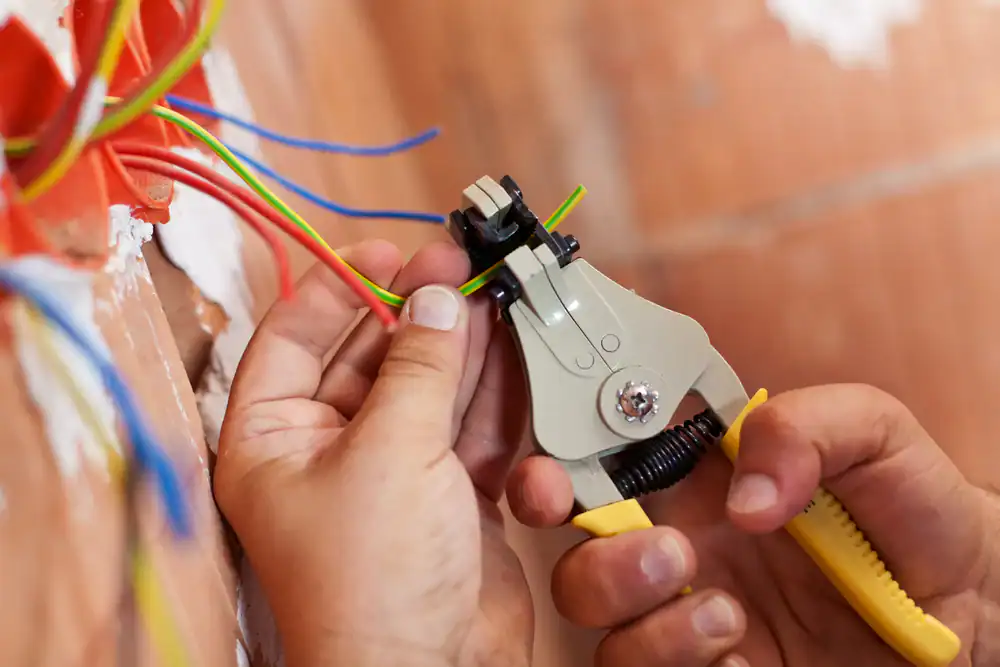
A proper Kohler standby generator installation is a multi-step process, and understanding what’s involved helps you know what to expect — and what to watch out for if a quote seems suspiciously fast or cheap.
It starts with a site assessment. Before any equipment is ordered or priced, a licensed electrician needs to evaluate your electrical panel, assess your fuel supply (natural gas line capacity or propane tank), identify the best location for the generator unit itself, and verify that the placement meets local code requirements for clearance from windows, doors, and vents. This step isn’t optional — it’s where proper sizing happens, and sizing is everything. A generator that’s too small for your actual load will struggle or fail when you need it most.
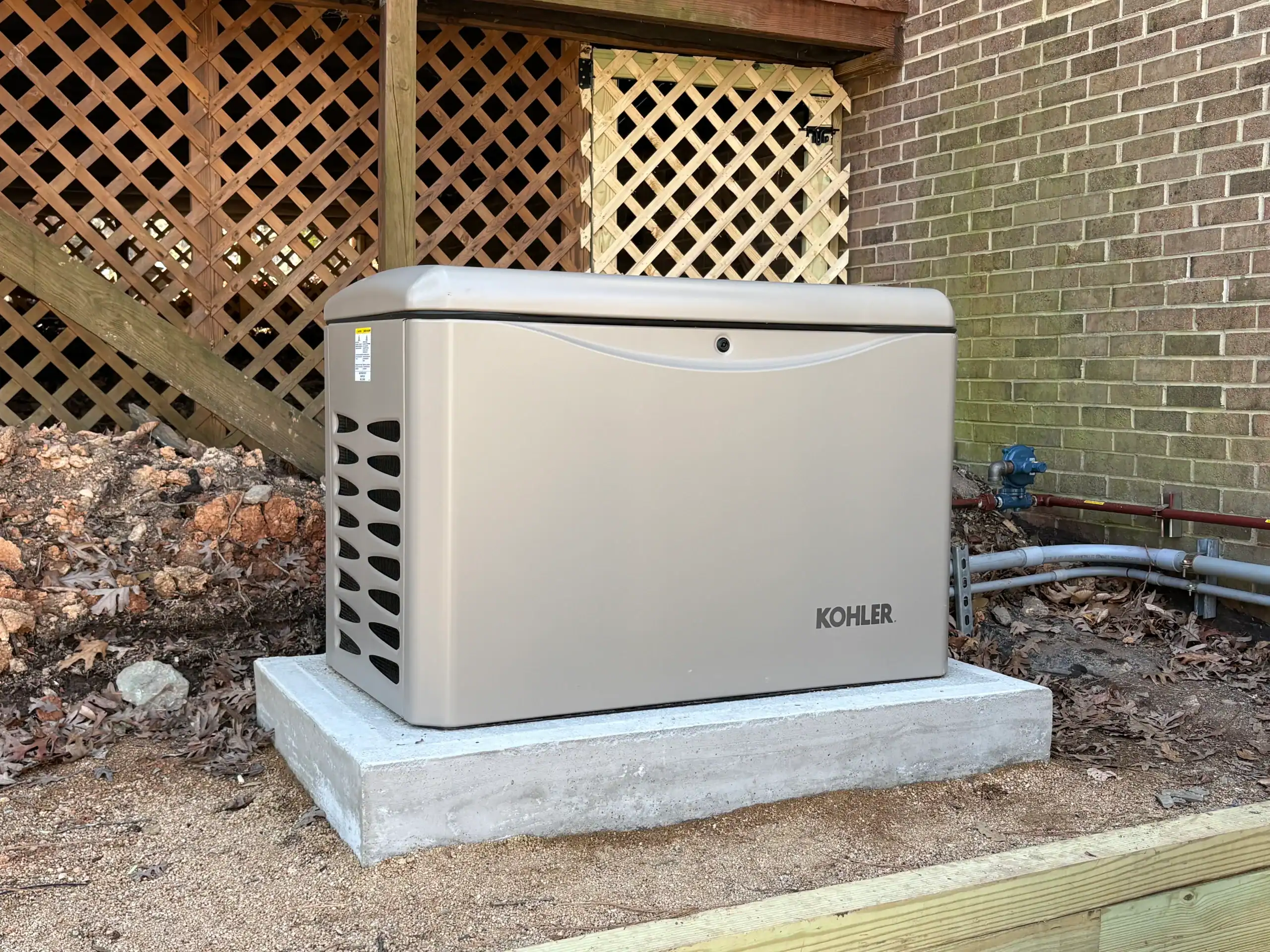
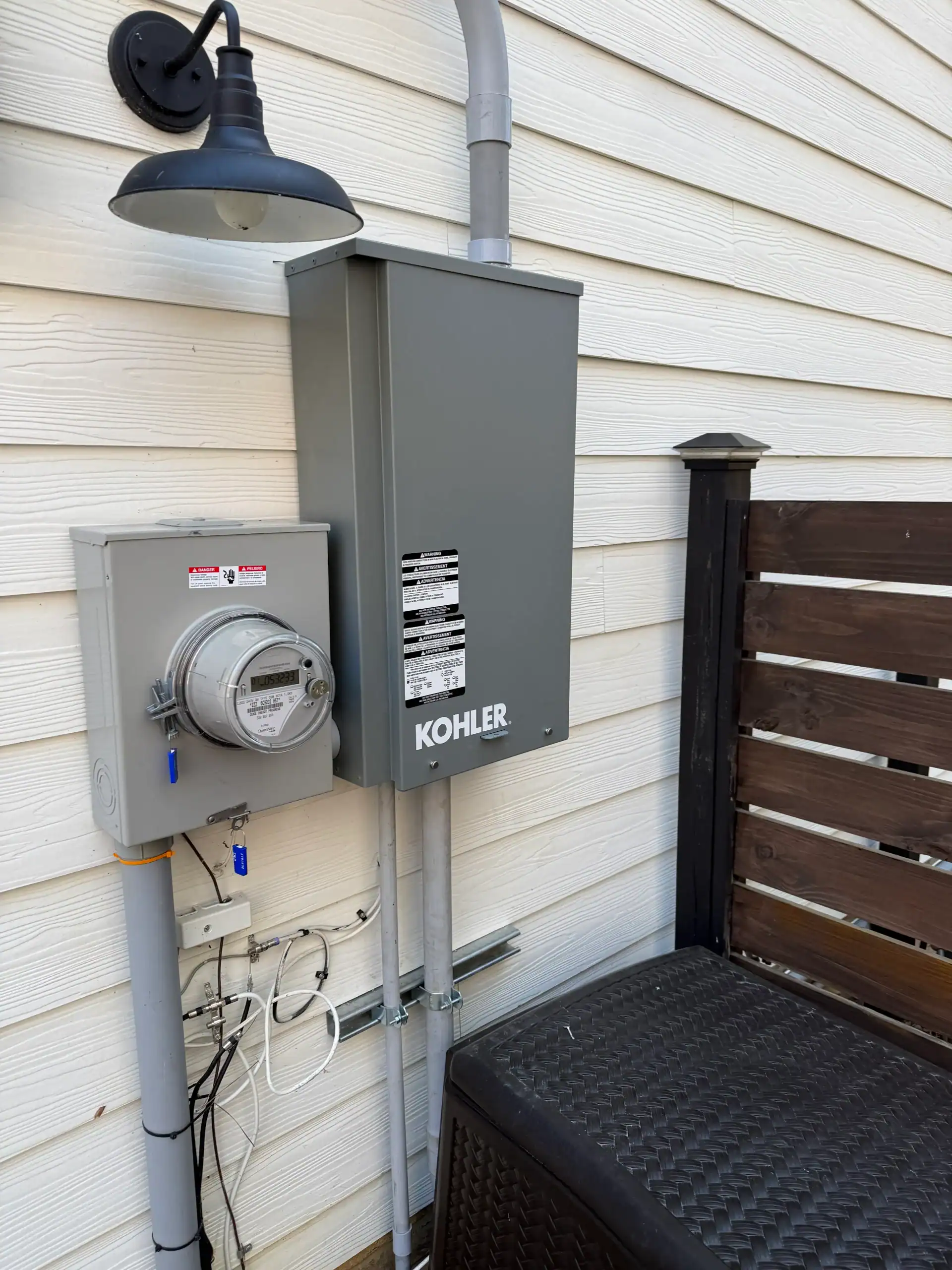
From there, a concrete pad is typically poured to provide a stable, level surface for the unit. The automatic transfer switch — the component that detects an outage and switches your home’s power source from the utility to the generator — is installed at your electrical panel. The fuel line connection is made by a qualified professional. The unit is wired, tested, and inspected.
In most jurisdictions across Alamance, Durham, Orange, Chatham, and Guilford Counties, this installation requires a building permit. A licensed electrical contractor pulls that permit, coordinates with the local building inspector, and closes it out after the work passes inspection. This protects you — unpermitted work can create complications with your homeowner’s insurance and with future property sales. We handle that coordination as part of every installation we do.
The whole process, from site assessment to final testing, is what we mean when we describe turnkey installation. You don’t need to manage multiple contractors or figure out who’s responsible for what. We handle it from start to finish.
This is where timing becomes a real strategic consideration, and it’s something most homeowners don’t think about until they’ve already missed the window.
Hurricane season runs from June through November. The NC Piedmont and Triad regions are not coastal — but they are not insulated from tropical systems either. Hurricane Helene in September 2024 caused widespread, extended outages across inland NC, including communities throughout Alamance, Durham, Orange, Chatham, and Guilford Counties. Before Helene, storms like Florence and Matthew left portions of our service area without power for days. The pattern is consistent, and it’s intensifying.
Ice storms are the second major driver of extended outages in this region. When ice accumulates on power lines, restoration timelines stretch — especially in rural areas served by electric cooperatives like Piedmont Electric Membership Corporation, which covers portions of Alamance, Orange, and Chatham Counties. Five to ten days without power in January is a different kind of emergency than a summer thunderstorm outage.
The problem with waiting until after a storm to call about generator installation is that everyone else in the region is calling at the same time. Post-storm demand creates installation backlogs that can stretch four to eight weeks or longer, compounded by supply chain delays on equipment. The homeowners who get generators installed quickly after a major event are the ones who called before it.
For homeowners in Durham and Orange Counties who work remotely — and that’s a significant portion of the workforce in the Research Triangle corridor — a power outage during a workday is lost income, missed deadlines, and frustrated clients. For households in Chatham County, where growth from Chatham Park and surrounding development is bringing more families onto properties that still rely on well water, the stakes are even more concrete.
The practical advice is straightforward: if you’re thinking about a Kohler generator, the best time to act is before you need it. We can assess your home, size the right unit for your load, and get the installation scheduled without the pressure of an approaching storm or an active outage. That’s a much better conversation to have in the spring than in October.
The generator market is full of options, and sorting through them takes time most homeowners don’t have — especially when they’re making the decision in the middle of a stressful outage. What we’ve tried to do here is give you the honest version of what Kohler offers, what the installation process actually involves, and why the credentials of the company you hire matter as much as the brand on the unit.
We’ve been doing this work since 2002, and our master electrician has held his license since 1989. We’re an Authorized Kohler Dealer and a Licensed Generac Electrician — which means we can give you a real recommendation based on your home and your situation, not just the brand we happen to carry. Our pricing is flat-rate, quoted upfront, with no overtime charges and no surprises when the invoice arrives.
If you’re ready to talk through what backup power looks like for your home in Alamance, Durham, Orange, Chatham, or Guilford County, ESP Electrical Service Providers is a call away.
Article details:
Share:
Continue learning: