Not sure what size diesel generator your home actually needs? This guide walks through the real math — and the mistakes that catch most homeowners off guard.
Share:
Summary:
Most homeowners start thinking seriously about a backup generator right after the power goes out. Maybe it was a summer storm that knocked out Duke Energy service for two days, or last year’s ice event that left parts of Alamance County dark for longer than anyone expected. Whatever the trigger, the question that follows is almost always the same: what size do I actually need?
That’s a fair question — and a more complicated one than most sizing charts let on. We’ve put together this guide to walk you through the real process, flag the mistakes that cause generators to fail at the worst possible moment, and explain what a professional assessment actually looks at that an online calculator never will.
The basic idea behind generator sizing is straightforward: figure out how much power your home needs at its peak demand, then choose a generator that can handle that load with some room to spare. Where things get complicated is in the details — specifically, the difference between how much power an appliance uses while running versus how much it needs to start up.
Every motor-driven appliance in your home — your central AC unit, well pump, refrigerator compressor, sump pump — draws significantly more power the moment it kicks on than it does once it’s running. That gap is called starting surge, and it’s the number most homeowners never account for. A central AC system that runs at 3,500 watts can demand 7,000 to 10,500 watts at startup. If your generator can’t handle that spike, it trips — right when the temperature outside is 95 degrees and the power’s been out for six hours.
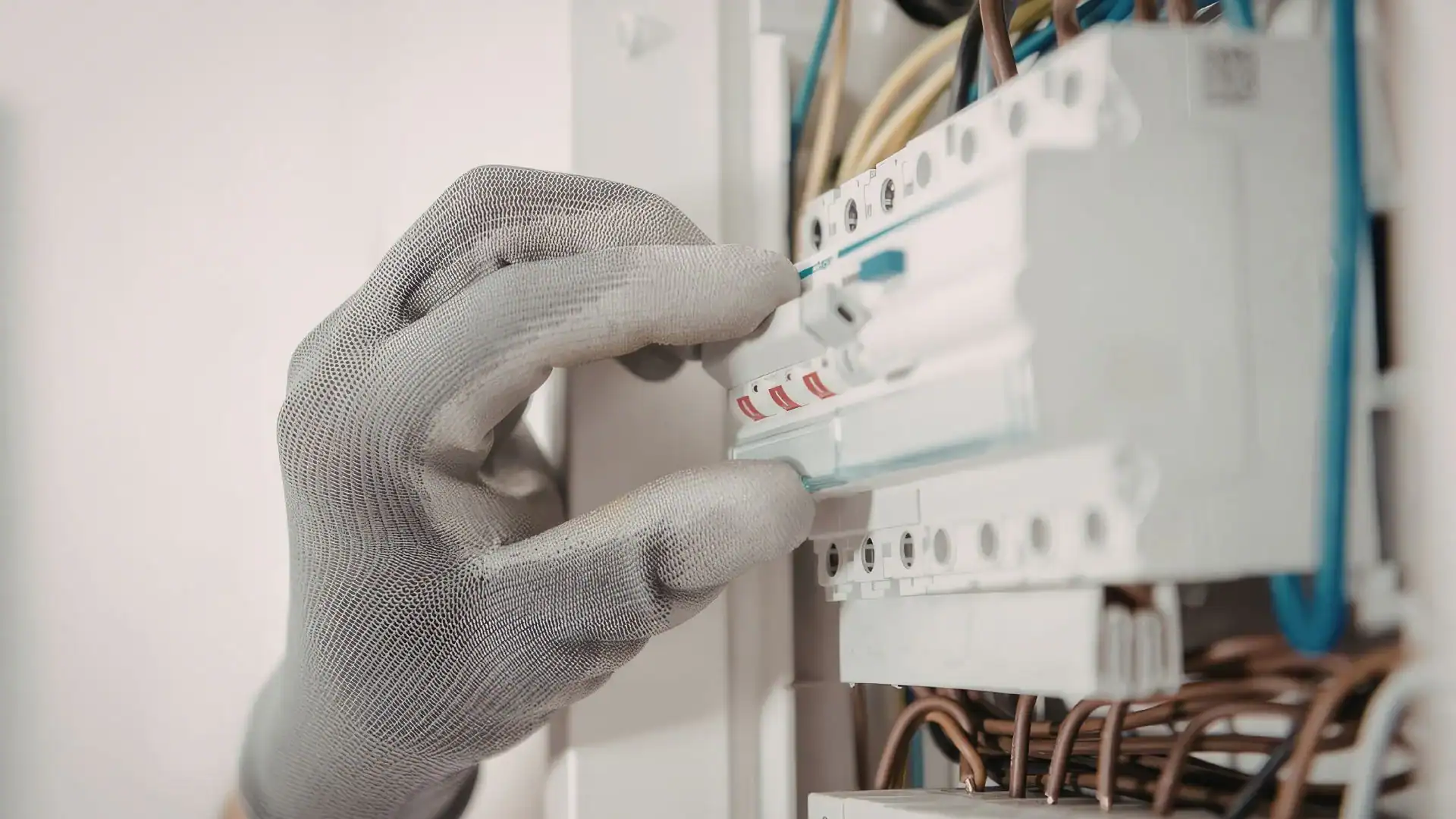
The first step in any accurate sizing process is building a realistic picture of your home’s electrical load. That means going through your home circuit by circuit — not room by room, and definitely not just square footage — and identifying every appliance and system you want the generator to power.
For most homes in Alamance County, that list includes the HVAC system, water heater, refrigerator, freezer, lighting, security system, and any medical devices in the household. If your home is on a private well, the well pump goes on that list too — and it’s a big one. Well pumps are common throughout rural parts of the county, from Snow Camp out to Ossipee, and they carry starting wattage requirements of 2,000 to 3,000 watts that urban sizing guides routinely leave out.
Once you have your list, you need two numbers for each item: running watts and starting watts. Running watts is what the appliance draws during normal operation. Starting watts is the surge required to get it going. Your generator needs to handle the total running load plus the highest single starting surge at any given moment — because that’s the real peak demand your system will face.
From there, a proper sizing calculation applies what electricians call a demand factor or load diversity factor, typically between 0.6 and 0.8 for residential properties. This accounts for the reality that not every appliance in your home runs at the same time. A professional load calculation uses this factor to avoid oversizing — because a generator that’s too large for its actual load runs inefficiently, burns more fuel, and in diesel units specifically, can cause a condition called wet stacking where incomplete combustion gradually damages the engine.
The final step is adding a safety margin of 20 to 30 percent above your calculated load. This gives you headroom for future additions — a new appliance, an EV charger, a home office setup — without having to replace the generator in five years.
If you’ve looked at generator spec sheets, you’ve probably seen both kW and kVA listed — sometimes with different numbers — and wondered which one actually matters. Here’s the short version: kW is the real power your generator delivers to your loads. kVA is the apparent power, which includes both real power and the reactive power that motors and compressors draw. The relationship between them is called the power factor, and for most residential generators it sits around 0.8.
What that means practically is that a generator rated at 10 kVA delivers 8 kW of usable power. If you size your home’s needs at 8 kW and buy a generator rated at 8 kVA, you’re already short before you’ve plugged anything in. This is one of the more common oversights in DIY generator sizing — comparing kW load requirements against kVA generator ratings without accounting for the conversion.
The formula itself isn’t complicated: divide your kW load by the power factor to get the kVA you need. An 8 kW load requires a 10 kVA generator at minimum, and that’s before your 20 to 30 percent safety margin. Where it gets tricky is making sure you’re using the right numbers throughout — actual running watts, accurate starting surge figures, and real demand factors based on how your household actually operates. That’s the part that takes experience to get right, and it’s the part where a professional assessment earns its value.
For reference, most homes under 2,000 square feet land in the 10 to 15 kW range for whole-home coverage. Homes between 2,000 and 3,000 square feet typically need 15 to 22 kW. Larger homes above 3,000 square feet can run from 22 kW up to 36 kW or more, depending on how many high-draw systems they’re running. But those are rough benchmarks — your actual number depends on your specific home, your specific appliances, and how you use them.
Want live answers?
Connect with a Electrical Service Providers expert for fast, friendly support.
Sizing a generator for a home in Burlington, Mebane, or Graham isn’t the same as sizing one for a home in Phoenix or Minneapolis. The load profile here is shaped by the local climate, the housing stock, and the specific ways the grid tends to fail in central North Carolina — and all of that should factor into the sizing conversation.
Alamance County sits in the Piedmont, which means hot, humid summers with sustained AC demand, cold winters with real ice storm risk, and a hurricane season that sends weakened but still destructive systems right through the middle of the state. North Carolina ranks fourth nationally for weather-related power outages, and the Piedmont’s above-ground distribution lines — running through mature tree canopy across much of the county — are among the most vulnerable infrastructure Duke Energy manages.
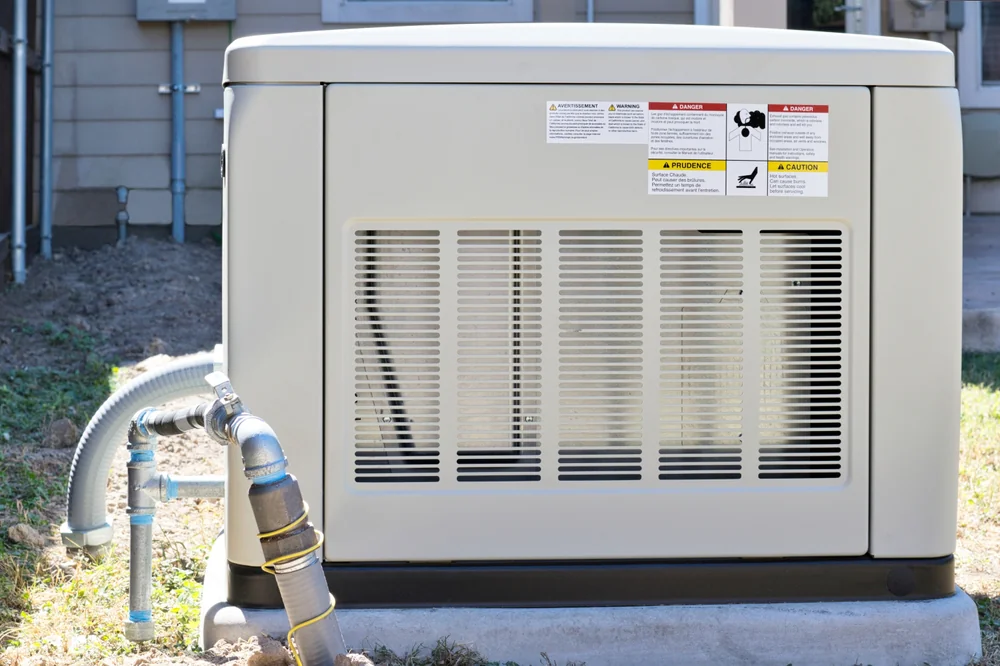
One thing most generic sizing guides skip entirely is the fact that your home’s power demand isn’t constant throughout the year. In Alamance County, the difference between a July afternoon and a January ice storm is significant — and your generator needs to be sized for the peak, not the average.
In summer, the dominant load is your HVAC system. Central air conditioning is one of the highest-draw appliances in any home, and in the Burlington area, it runs hard from late May through September. July highs in Burlington regularly reach the low-to-mid 90s with high humidity, which means your AC isn’t just running — it’s cycling frequently, creating repeated starting surges throughout the day. If your generator is sized too close to your running load with no headroom, those repeated startup spikes will wear on the system and eventually trip it.
Winter brings a different challenge. Ice storms are the Piedmont’s most damaging weather event, and Alamance County is squarely in what meteorologists call the Southeast ice belt — the zone where Gulf moisture meets cold mountain air and produces freezing rain rather than snow. Ice accumulation on power lines and trees causes outages that last days, not hours. When those outages hit in January, your heating system, water pipes, and any medical equipment in the home are all under pressure at the same time.
The practical takeaway is that your generator sizing calculation should be run twice — once for peak summer demand and once for peak winter demand — and the larger of the two numbers should drive your decision. A licensed electrician doing a proper load assessment will account for both scenarios automatically. An online calculator almost certainly won’t.
Online sizing calculators are a reasonable starting point for getting a ballpark number. But there’s a meaningful gap between a ballpark and an accurate load calculation — and that gap is where generators get undersized, overstressed, and ultimately fail when you need them most.
A professional load assessment does several things an online tool can’t. It looks at your actual panel, not a generic appliance list. We measure the real electrical characteristics of your home, including power quality issues that can affect how your generator performs under load. We use thermal imaging and power quality assessment tools to get an accurate picture of what your home’s electrical system is actually doing — not what a spec sheet says it should be doing. That matters more than most homeowners realize, especially in older homes where the panel may not reflect what’s actually connected downstream.
We’ve been doing this work in Alamance County since 2002. In that time, we’ve assessed homes in Burlington’s older neighborhoods where the panel is original to the house, rural properties outside Graham and Haw River where well pumps and outbuildings add load that never shows up on a standard checklist, and newer construction in Mebane where high-efficiency HVAC systems have different startup characteristics than older equipment. Every home is different, and the sizing recommendation should reflect that.
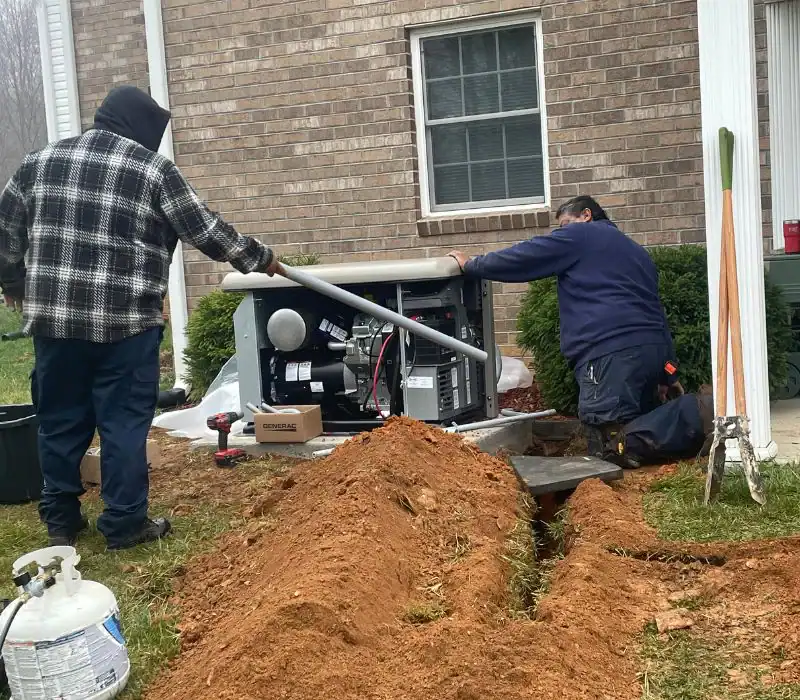
There’s also the permit side of the equation. Generator installation in North Carolina requires permits and electrical inspections, and the permit application has to include a load calculation prepared to NEC Article 220 standards. We handle all of that — the application, the documentation, the coordination with Alamance County authorities — so you’re not navigating an unfamiliar process on top of an already significant purchase. The goal is a system that’s sized correctly, installed to code, and backed by a manufacturer-certified installation from a team that’s been in this county long enough to know what it actually takes.
Getting generator sizing right comes down to three things: knowing your actual load, accounting for starting surge, and building in enough margin for the conditions your home will realistically face. For Alamance County homeowners, those conditions include summer heat, winter ice, and a grid that — by the numbers — goes down more often than most people expect.
The math is learnable. But the assessment that produces a number you can actually trust takes tools, experience, and familiarity with how homes in this part of North Carolina are actually built and used. An online calculator gives you a starting point. A professional load calculation gives you confidence.
If you’re ready to get a real answer for your home, reach out to us. We’re based in Burlington and have been sizing, installing, and servicing home generators across Alamance County for over 20 years. Call us at 336-228-3300 and we’ll walk through it with you.
Article details:
Share:
Continue learning: