Bought an EV and wondering if your home can actually support a Level 2 charger? Here's the honest breakdown — no fluff, no guesswork.
Share:
Summary:
You bought an EV to stop depending on gas stations. But if you’re plugging into a standard outlet every night and waking up to 40% charge, you’ve traded one problem for another. For most people commuting out of Alamance County — whether you’re heading west on I-40 toward Greensboro or east toward Durham and the Triangle — a Level 1 charger just doesn’t keep up with daily driving. A Level 2 installation changes that completely. Here’s what it involves, what it costs in the real world, and what homeowners in Burlington, Mebane, Graham, and the surrounding area need to know before they call anyone.
Level 1 charging uses your standard 120-volt outlet — the kind already in your garage. No installation required, but the tradeoff is speed: you’re adding roughly 3 to 5 miles of range per hour. If you drive 50 miles round-trip and get home with a depleted battery, you’d need 10 to 16 hours just to restore that charge. For most drivers, that math doesn’t work.
Level 2 charging runs on a 240-volt circuit — the same type of circuit your dryer or range uses — and adds anywhere from 14 to 44 miles of range per hour depending on the charger’s amperage. A 40-amp charger delivers about 9.6 kilowatts of power, which means most EVs go from nearly empty to fully charged overnight without any planning or stress. Plug in after dinner, full battery by morning.
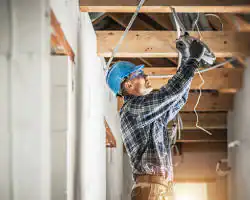
The installation itself isn’t complicated when everything lines up — but there are a few steps that matter, and skipping any of them creates problems down the road.
It starts with a panel assessment. Before anything gets mounted or wired, a licensed electrician needs to look at your electrical panel and confirm it has the capacity to support a new dedicated 240-volt circuit. A 200-amp panel with available breaker space usually handles this without issue. Older homes — and Alamance County has plenty of them, particularly in the established neighborhoods built between the 1950s and 1980s — may have 100-amp service or panels that are already at capacity. That’s not automatically a dealbreaker, but it does change the scope and cost of the project. You want to know this before anyone starts pulling wire.
Once capacity is confirmed, the electrician runs a dedicated circuit from your panel to the charger location — typically inside the garage. “Dedicated” means nothing else shares that circuit. Not the garage lights, not a refrigerator, not a power tool outlet. The circuit breaker must be rated for at least 125% of the charger’s continuous output, which is why a 40-amp charger requires a 50-amp breaker. The wire gauge matters too: most residential Level 2 installations use 6 AWG or 8 AWG copper conductors, depending on the amperage and the distance from the panel to the charger.
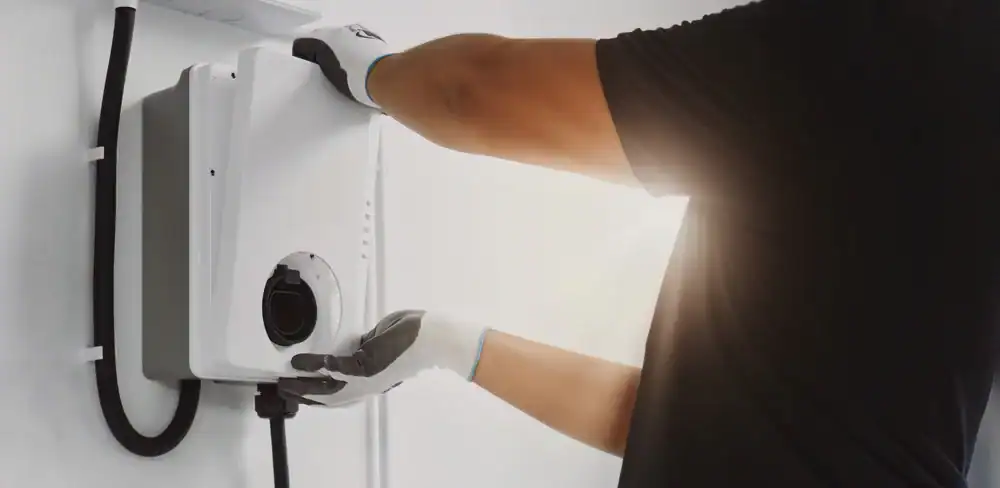
After the wiring is in place, the charger gets mounted and connected. Most homeowners choose a hardwired installation — it’s the cleaner, more permanent option and the one most jurisdictions prefer. A plug-in installation (where the charger plugs into a 240-volt outlet rather than being wired directly) is also an option, though hardwired is generally considered the better long-term setup.
The final step is the permit and inspection. In Alamance County, as in most of North Carolina, this work requires a permit and must pass inspection. That’s not a formality — it’s what protects you. A permitted, inspected installation is documented, code-compliant, and won’t create problems when you sell the home or file a claim with your insurance company. We handle the permit process and coordinate the inspection as part of every installation.
This is the question we hear most often, and it’s worth addressing directly because the answer isn’t always what people expect.
A lot of homeowners assume their panel will definitely need an upgrade — and they’re bracing for a big, expensive project before they’ve even gotten a quote. Others assume everything will be fine without checking. Neither assumption is useful. What actually determines whether you need a panel upgrade is a load calculation: a look at your current panel’s amperage, how many circuits are already in use, and how much headroom is left for a new 40- to 60-amp dedicated circuit.
If your home has 200-amp service and your panel isn’t already maxed out, there’s a good chance you don’t need an upgrade at all. The charger circuit goes in, the installation is done in a single visit, and you’re charging that night. That’s the straightforward scenario, and it’s more common than people think — especially in newer construction from the 2000s and 2010s in Mebane and other parts of Alamance County that came with 200-amp service already in place.
The more involved scenario shows up in older homes throughout the county. If your panel is a 100-amp service, or if it’s a 200-amp panel that’s already running close to capacity, a panel upgrade may be necessary before the charger can go in safely. This isn’t something to guess at or work around — undersized or overloaded circuits are a fire hazard, and no legitimate electrician is going to skip that step to save time.
The good news for Alamance County homeowners on Duke Energy service: there’s a $1,133 rebate available through Duke Energy Carolinas specifically for electrical upgrades that support a Level 2 charging station. If a panel upgrade is part of what your installation requires, that rebate can offset a meaningful portion of the cost. We know what Duke Energy requires for rebate approval in this area, and we handle that process for our customers — you don’t have to navigate it yourself.
Want live answers?
Connect with a Electrical Service Providers expert for fast, friendly support.
Once the electrical side is sorted, the other question is which charger to actually buy. The market has a lot of options, and the differences matter more than the brand names suggest.
The most important thing to know is that any Level 2 charger with a J1772 connector — which is the universal standard — works with any non-Tesla EV. Tesla vehicles come with a J1772 adapter, so a universal charger works for them too. You’re not locked into a brand-specific charger unless you want to be. Popular options we install include ChargePoint, JuiceBox, and Grizzl-E, along with Tesla Wall Connectors for customers who prefer the native Tesla setup.
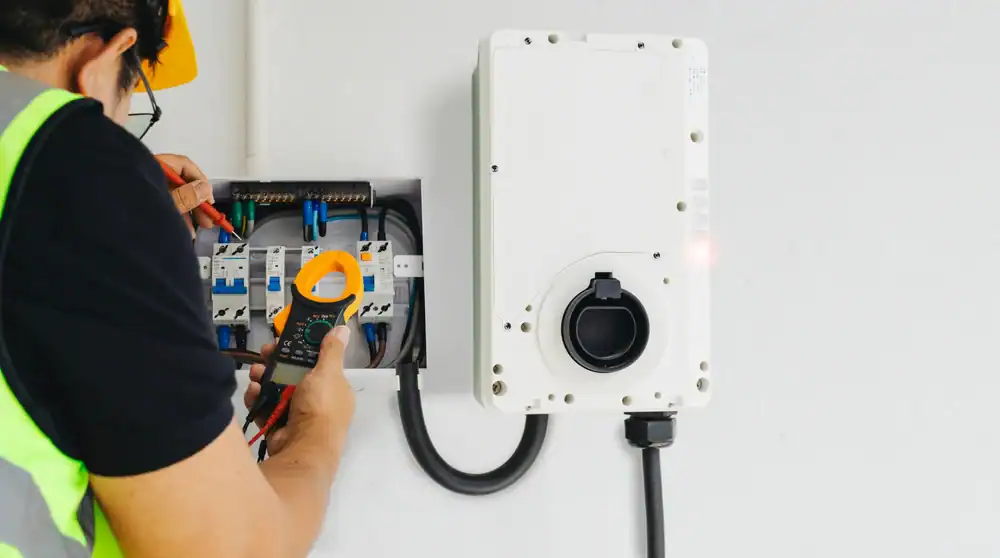
Amperage determines how fast your charger replenishes your battery, and the right answer depends on how you actually drive.
A 40-amp charger is the most common residential choice, and for most people, it’s more than enough. At 40 amps, you’re adding roughly 25 to 35 miles of range per hour. If you drive 50 to 60 miles a day — a realistic round-trip commute for someone based in Alamance County heading toward Durham or Greensboro — a 40-amp charger fully restores that range in two to three hours. Plug in at 10 p.m., and you’re at 100% well before you wake up.
A 48-amp or 50-amp charger pushes that closer to 44 miles per hour and is worth considering if you drive more than average, have a larger battery pack, or want to future-proof your setup for a second EV. The circuit requirements step up accordingly — a 48-amp charger needs a 60-amp breaker — so it’s worth discussing with your electrician before you purchase the unit.
One thing that trips people up: the charger’s amperage rating and your car’s onboard charger capacity both matter. If your vehicle’s onboard charger maxes out at 7.2 kilowatts, a 48-amp charger won’t charge it any faster than a 40-amp one. Knowing your car’s specs before you buy the hardware saves you from spending more than you need to.
We’re happy to talk through the options before you purchase anything. If you already have a charger in hand, we’ll install it. If you’re still deciding, we can help you match the right unit to your home’s electrical setup and your driving habits.
Technically, some people try. Practically, it’s not a good idea — and in most cases in North Carolina, it’s not legal.
A 240-volt circuit is not the same risk profile as swapping a light switch. Incorrect wiring at this voltage can cause fires, damage your EV’s charging system, or create shock hazards that aren’t obvious until something goes wrong. Beyond the safety issue, there’s the legal and financial side: most jurisdictions in North Carolina require a permit for this type of work, and permits require a licensed electrical contractor to pull them. If the work is done without a permit and something goes wrong — a fire, an insurance claim, a home sale that requires disclosure — unpermitted electrical work creates serious problems.
The NEC 2026 update made this even clearer, specifically requiring that hardwired Level 2 charging equipment be installed by a qualified, licensed person. Hardwired installations are the preferred setup for most homeowners, which means the professional installation requirement isn’t a technicality — it’s the standard.
There’s also the warranty angle. Most EV charger manufacturers void the warranty if the unit wasn’t installed by a licensed electrician. And if you’re planning to claim the Duke Energy rebate — which requires documentation of a proper installation — a DIY job won’t qualify.
The cost of a professional installation is real, but so is the protection it provides. A permitted, inspected installation is one that’s documented, safe, and won’t come back to haunt you. We’ve been doing this work in Alamance County since 2002, and we’ve seen what happens when corners get cut on electrical work. It’s not worth it.
The bottom line is straightforward: if you own an EV and you’re doing any real driving, a Level 2 charger is what makes home charging actually work. The installation process is manageable, the Duke Energy rebate makes it more affordable than most people expect, and the difference in your daily routine — waking up to a full battery instead of scrambling for a public charger — is immediate.
What matters is getting it done right. That means a proper panel assessment, a dedicated circuit sized for the charger you’re running, a permit, and an inspection. No shortcuts, no surprises.
We give you the price before we start — flat-rate, no hourly billing, no scope creep. Our trucks are fully stocked, and most installations are completed in a single visit. If you’re in Burlington, Mebane, Graham, or anywhere else in Alamance County, reach out to ESP Electrical Service Providers and let’s figure out exactly what your home needs.
Article details:
Share:
Continue learning: