Not all electrical inspections follow the same script. Here's what NC inspectors actually look for — and why older Alamance County homes often raise the most questions.
Share:
Summary:
You got a report. Maybe from a home inspector, maybe from your gut — something about the electrical in this house doesn’t feel right. Now you’re trying to figure out what an actual electrical inspection covers, what order things get checked, and whether what you’re dealing with is a minor fix or a real problem.
That’s exactly what this page is for. We’re going to walk through the NC electrical inspection checklist the way a licensed electrician actually uses it — not a generic national template, but the real sequence, with current NC code context and the specific factors that come up most often in Alamance County homes.
An electrical inspection isn’t a single sweep through the house with a flashlight. It’s a structured evaluation that follows a defined sequence — and in North Carolina, that sequence is anchored to the 2023 NEC, which the state adopted effective January 1, 2024, as the standard for all new permits statewide.
The inspection starts at the service entrance — the point where power comes into the building — and works inward from there. Panel first, then branch circuits, then individual outlets, switches, and fixtures. There’s a logic to that order: if the panel is undersized, overloaded, or wired incorrectly, everything downstream is suspect regardless of how clean the outlets look.
For existing homes, the picture is more layered. Work performed on an existing electrical system triggers compliance with the current code for whatever’s being done, even if the rest of the house is grandfathered. That’s a distinction that catches a lot of homeowners off guard — and it’s one reason an inspection before any renovation is worth doing.

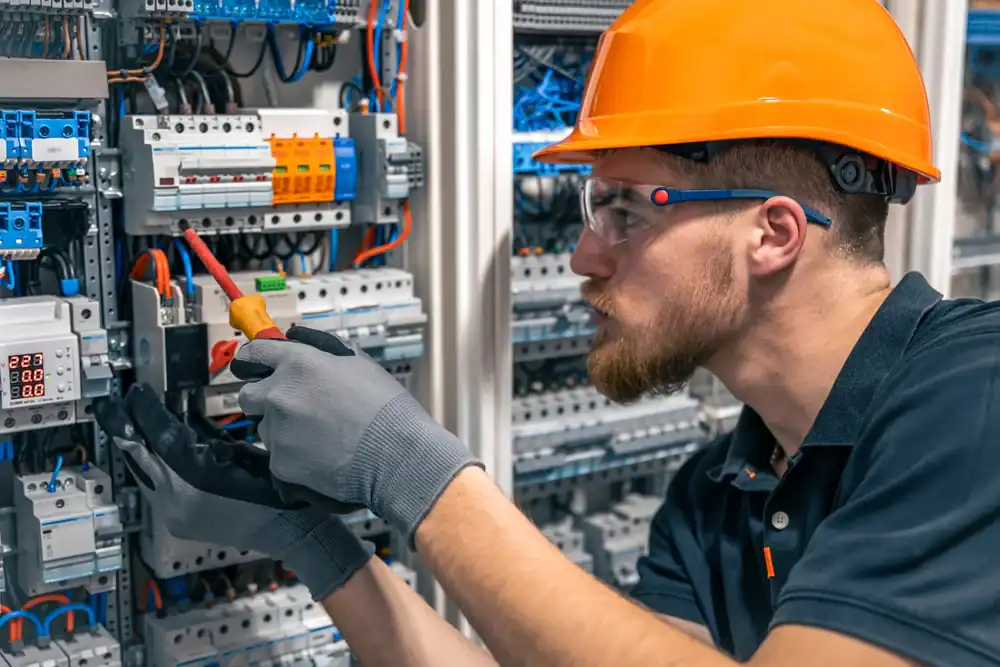
The panel is always the starting point, and for good reason. Everything in your home’s electrical system flows through it. When we inspect a panel — or when a homeowner calls us in for a pre-purchase or safety evaluation — we look at several things before we ever touch an outlet.
First is amperage. Panels in homes built before the 1990s were commonly rated for 60 or 100 amps. That was adequate for the loads of that era. It is not adequate for a modern home running central HVAC, a dishwasher, a refrigerator, a home office, and possibly an EV charger. A 60-amp panel in a Burlington home that’s changed hands three times since 1965 is not just outdated — it’s a liability.
Next is breaker condition and labeling. Breakers should be clearly labeled, matched to the correct wire gauge for each circuit, and free of signs of overheating or corrosion. Double-tapped breakers — where two wires are connected to a single breaker terminal that isn’t rated for it — are one of the most common violations we find in older panels. They’re also one of the most consistently missed by general home inspectors.
AFCI (arc fault circuit interrupter) protection is another item on the panel checklist. Under the 2023 NEC, AFCI breakers are required on an expanded list of circuits. One detail that matters here: combination AFCI breakers are panel-specific. A breaker verified for one manufacturer’s panel cannot be installed in a different manufacturer’s enclosure and pass inspection. That’s the kind of detail that trips up DIY work and unlicensed installs.
The grounding electrode system also gets evaluated. NEC 250.52 requires rod electrodes to be at least eight feet in length. The grounding electrode conductor — the wire connecting the panel to that rod — needs to be properly sized and connected. This isn’t glamorous, but a failed ground is a serious safety issue.
Finally, the physical condition of the panel enclosure itself: the cover must be present, all knockout openings must be filled, and there should be no evidence of moisture intrusion, scorching, or melted components. Any of those signs points to a problem that has already been developing — possibly for years.
This is where the local context matters — and Alamance County has a specific story worth telling.
Roughly 41% of Burlington’s housing stock was built before 1970, according to neighborhood-level data from NeighborhoodScout. The median construction year for homes across Alamance County is 1988, which means the average home here is nearly 40 years old. In older Burlington neighborhoods, in the mill-era housing along Haw River, and in the postwar ranch homes across Graham and Alamance, you’ll find electrical systems that reflect every decade of code and every generation of owner who made changes without pulling a permit.
One of the most significant issues in that vintage of housing is aluminum branch-circuit wiring. Solid aluminum wiring was commonly used in residential construction between 1965 and 1973 as a cost-saving alternative to copper. The problem is that aluminum oxidizes, expands and contracts with temperature changes more than copper does, and tends to loosen at connection points over time. According to CPSC data, homes with aluminum branch circuits are 55 times more likely to reach fire hazard conditions at connections than copper-wired homes. That’s not a rounding error — that’s a categorically different risk profile.
When we inspect a home from this era, we look specifically for aluminum wiring, evaluate the condition of connections at outlets, switches, and the panel, and assess whether the installation has been properly maintained or modified. A general home inspector may note the presence of aluminum wiring, but they typically won’t evaluate the connections in any depth — that requires a licensed electrician with the right tools and the right training.
Thermal imaging is one of those tools. We use it during inspections because it detects heat signatures inside walls and panels that are completely invisible to the naked eye. A connection that’s beginning to fail under load will show up on a thermal camera before it shows up as a tripped breaker, a burning smell, or worse. It’s not standard practice for most electricians in the area, but it’s part of how we work — because the things you can’t see are often the things that matter most.
Want live answers?
Connect with a Electrical Service Providers expert for fast, friendly support.
Two acronyms come up constantly in electrical inspections, and they’re worth understanding before you walk into a conversation with an inspector or a contractor.
GFCI stands for ground fault circuit interrupter. These are the outlets with the test and reset buttons — you’ve seen them in bathrooms and kitchens. They’re designed to cut power in milliseconds if they detect a current leaking to ground, which is what happens when electricity is traveling through a person. Lack of GFCI protection accounts for approximately 67% of preventable shocks in damp areas, according to OSHA and ESFI data.
AFCI stands for arc fault circuit interrupter. These work differently — they’re designed to detect the irregular electrical signature of an arc fault, which is what happens when damaged or loose wiring creates a spark inside a wall. Arc faults are a leading cause of residential electrical fires, and they often produce no visible symptoms until something ignites.
The 2023 NEC expanded GFCI requirements significantly compared to earlier editions. Under the current code, which applies to all new permits issued in North Carolina as of January 1, 2024, GFCI protection is required in bathrooms, kitchens (for receptacles serving countertop surfaces), garages, outdoors, unfinished basements, crawl spaces, laundry areas near water sources, and near clothes dryers.
For existing homes, the picture is more nuanced. A home built in 1968 is not required to retroactively install GFCI protection throughout the house simply because the code has changed. But if you’re replacing an outlet in a bathroom, adding a circuit in the garage, or doing any work that requires a permit, the new work must comply with current code. That’s where a lot of homeowners get surprised — they thought they were doing a small update, and the inspector flags a GFCI requirement they didn’t anticipate.
There’s also a common misconception that a GFCI outlet protects only the device plugged into it. A correctly wired GFCI outlet can protect all downstream outlets on the same circuit — but only if it’s wired that way. If someone installed a GFCI outlet in a bathroom but wired it as a standalone device rather than a circuit protector, the outlets further down the circuit aren’t covered. That’s a code compliance issue that looks fine on the surface and only shows up when you test it properly.
In Alamance County homes from the 1950s through the 1970s, GFCI protection is almost universally absent in locations that now require it. That’s not a moral failing of the previous owners — it simply wasn’t required when those homes were built. But it is a real safety gap, and it’s one of the first things we identify during an inspection of an older home.
One NC-specific note: the 2023 NEC includes an exception for submersible well pumps, which are not required to have GFCI protection under North Carolina’s adopted amendments. That matters for rural properties in Alamance County where well systems are common.
This comes up constantly, and it’s worth addressing directly: a home inspector’s electrical check is not the same thing as a licensed electrician’s inspection. They serve different purposes, they’re performed by people with different training, and they produce very different levels of detail.
A home inspector performs a non-invasive visual assessment of the home’s systems. They’re generalists — trained to identify obvious red flags across plumbing, roofing, HVAC, structure, and electrical. When they look at the electrical system, they’re typically checking the panel for visible concerns, noting the presence or absence of GFCI outlets in required locations, and flagging anything that looks obviously wrong. Their reports use language like “recommend further evaluation by a licensed electrician” — because that’s the honest scope of what they can assess.
A licensed electrician’s inspection goes considerably deeper. We can open the panel and evaluate what’s inside. We can test GFCI and AFCI devices for proper function, not just presence. We can use thermal imaging to identify heat signatures that indicate developing problems. We can assess wire gauge against breaker sizing, check for double-tapped breakers, evaluate the grounding electrode system, and identify aluminum branch-circuit wiring. We can tell you not just that something looks concerning, but what it means, what code requires, and what it would take to address it.
If you’ve received a home inspector’s report with electrical concerns flagged, that report is the beginning of the conversation — not the end of it. The inspector did their job. Now you need someone who can answer the questions that report raised.
An electrical inspection checklist is only useful if someone qualified is actually running through it. The code references, the panel evaluation, the GFCI and AFCI testing, the thermal imaging — none of that happens on a general home inspection report. It happens when a licensed electrician walks through the door with the right tools and the right experience.
We’ve been doing this work in Alamance County since 2002. Andy Helton, our Master Electrician, has been licensed since 1989 — which means he’s been evaluating electrical systems in homes like yours for longer than most of those homes have been on the market twice. When we look at a panel in a 1962 Burlington ranch or a 1970s split-level in Graham, we’re not working from a generic checklist. We know what those systems look like, what they were built with, and where they tend to fail.
That experience matters. Faulty wiring causes approximately 52% of residential electrical fires in the United States each year. The homes in Alamance County’s older neighborhoods aren’t immune to that statistic — and the fact that the lights are on doesn’t mean the system is safe. A functioning electrical system and a safe electrical system are not the same thing.
If you’re in Burlington, Graham, Mebane, Haw River, or anywhere else in Alamance County and you have questions about your home’s electrical system — whether you’re buying, selling, renovating, or just haven’t had anyone look at it in years — we can help. We give you a clear picture of what’s there, what it means, and what needs to happen next. No guesswork, no pressure, no hourly billing surprises.
Reach out to ESP Electrical Service Providers and speak with a real person who understands what you’re dealing with.
Article details:
Share:
Continue learning: