Older Alamance County homes come with charm — and sometimes outdated wiring that can't keep up with modern life. Here's what to know.
Share:
Summary:
If your home was built before 1960, there’s a good chance the electrical system inside the walls was designed for a completely different era. Not a worse era, necessarily — just one where a refrigerator, a few light fixtures, and a radio were considered a full electrical load. Today, you’re running central air, a washer and dryer, a home office, smart devices, and maybe an EV charger off that same infrastructure. Something’s got to give.
Alamance County’s housing stock includes a significant number of homes from the mill era — the 1910s through the 1950s — and those homes were built with wiring standards that haven’t been current for decades. Here’s what that actually means for you.
Knob and tube wiring was the standard residential wiring method from roughly the 1880s through the 1940s. It gets its name from the ceramic knobs that hold the wires in place along joists and studs, and the ceramic tubes that protect wires where they pass through wood. If your Alamance County home was built during the textile mill boom, there’s a real possibility it still has some of this wiring active in the walls.
Here’s the thing: knob and tube wiring wasn’t poorly designed for its time. The problem isn’t the original system — it’s what’s happened to it since. Decades of modifications by previous owners, insulation added around the wires during weatherization projects, and natural deterioration of the cloth and rubber insulation all turn a once-functional system into a legitimate hazard.
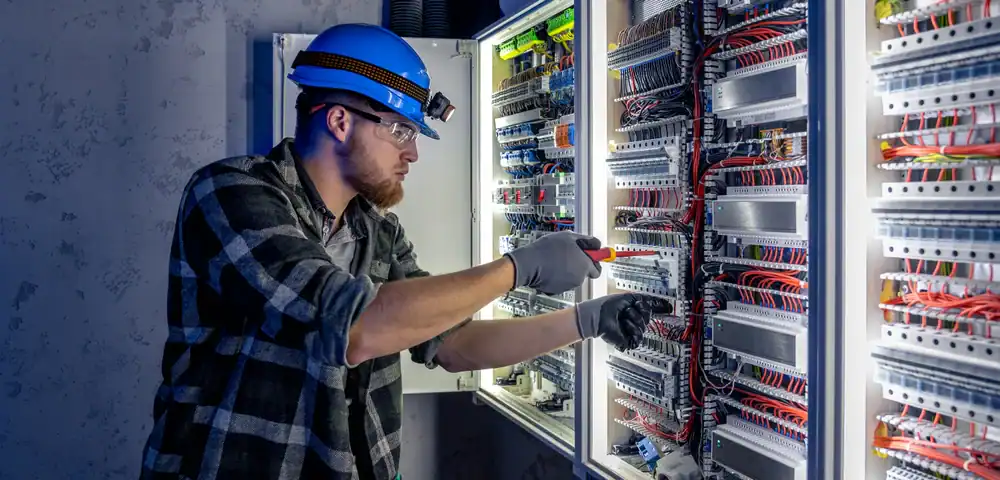
The three things that make old knob and tube wiring genuinely risky are age-related insulation breakdown, improper modifications, and building insulation packed around the wires. Each one is worth understanding on its own.
Insulation breakdown is straightforward. The cloth and rubber coating on knob and tube wiring wasn’t built to last a century. As it ages, it becomes brittle and cracks. In some cases it falls away entirely, leaving bare conductors inside your walls. That’s not a theoretical risk — it’s a fire waiting for the right conditions.
The modification problem is more common than most homeowners realize. Over the decades, previous owners, handymen, and well-meaning family members may have spliced into the original wiring to add outlets, extend circuits, or connect new appliances. Those connections were often made without the right materials, without permits, and without any inspection. The result is a patchwork system where the original wiring is only part of the story — and the newer additions may be the more dangerous part.
The insulation issue catches a lot of homeowners off guard. If your home has been weatherized — blown-in insulation added to the attic or walls — and that insulation is packed around knob and tube wiring, you have a problem. Knob and tube wiring was designed to dissipate heat into open air. Surround it with insulation, and that heat has nowhere to go. That’s how fires start in attics that haven’t been touched in years.
There’s also the grounding issue. Knob and tube wiring has no ground wire. That means it cannot safely service any modern three-prong appliance, and it offers no path for fault current to safely dissipate. It’s not just an inconvenience — it’s a gap in protection that the entire system was built without.
If a home inspector flagged knob and tube wiring in your Alamance County home, the right move is a professional assessment, not panic. Some K&T systems are in better shape than others. But “not immediately dangerous” and “fine to leave alone indefinitely” are two very different things, and only someone who can actually see the wiring can tell you which category you’re in.
This is the question a lot of Alamance County homeowners don’t think to ask until they’re already in trouble. The answer is yes — and it can affect you in ways that are more immediate than a fire risk.
North Carolina’s homeowner insurance market has tightened considerably in recent years. Some insurers won’t write a new policy on a home with active knob and tube wiring at all. Others will cover the home but require remediation as a condition of continued coverage, or charge a significant premium surcharge. If you’re buying an older home in Alamance County and the inspection report flags K&T wiring, that’s not just a negotiating point — it’s a potential coverage issue you need to resolve before closing.
The resale side of this is equally real. When you eventually sell your home, a buyer’s inspector will flag active knob and tube wiring. That puts you in the position of either negotiating a price reduction, agreeing to remediate before closing, or watching the deal fall apart. Buyers moving into Alamance County from the Research Triangle — and more of them are buying here every year as Triangle prices climb — often aren’t familiar with the wiring issues common in older Piedmont homes, which means they may react with more alarm than a local buyer would.
The practical takeaway is that knob and tube wiring isn’t just a safety issue. It’s a financial one. And the longer it stays in place, the more it shapes your options — on insurance, on renovations, and on resale. Getting a professional assessment now, while you’re not under pressure, is a much better position than discovering the problem during a sale negotiation or an insurance renewal.
Want live answers?
Connect with a Electrical Service Providers expert for fast, friendly support.
The grounding conductor wasn’t standard in residential wiring until around 1962. That means any home built before that year — which covers a substantial portion of Alamance County’s older neighborhoods — is likely to have at least some circuits without a true ground. You may not even know it.
Many older homes have had their two-prong outlets swapped out for three-prong ones at some point, which looks like an upgrade but isn’t one if the underlying circuit was never grounded. A three-prong outlet on an ungrounded circuit doesn’t provide ground protection. It just looks like it does.

A ground wire gives fault current somewhere safe to go. When something goes wrong in a circuit — a surge, a short, a wiring fault — the ground path routes that energy away from you and your devices and into the earth, where it dissipates harmlessly. Without that path, the fault current looks for the next available conductor. Sometimes that’s your appliance. Sometimes it’s you.
For electronics, the risk is more about damage than immediate danger. Computers, TVs, and other sensitive equipment rely on a stable ground reference to function correctly. Ungrounded circuits can cause voltage fluctuations that shorten the life of your devices or damage them outright during a power event. Surge protectors, for what it’s worth, don’t work properly on ungrounded circuits — the ground connection is part of how they do their job.
The fire risk comes from a different mechanism. Ungrounded circuits that are overloaded — running more current than they were designed to handle — have no fault path to trigger a breaker trip. That means the overload can persist longer than it should, building heat in the wiring inside the walls. In older Alamance County homes where the wiring itself is already aged, that combination is exactly the kind of thing that causes fires in places you can’t see until it’s too late.
You might be wondering whether a GFCI outlet solves this. It’s a fair question, and the answer is: partially. GFCI outlets detect ground fault conditions and cut power automatically, which is meaningful protection in kitchens and bathrooms. They’re also a code-compliant workaround in certain locations. But they don’t provide surge protection the way a true ground does, and they don’t fully replicate what a grounded circuit offers for sensitive electronics. A GFCI is a reasonable interim measure in some situations — it’s not a complete solution.
The other thing worth knowing is that swapping a two-prong outlet for a three-prong outlet without adding a real ground wire isn’t just ineffective — it’s a code violation. It creates the appearance of safety without the substance, and it can create liability problems at resale when an inspector catches it.
Short answer: no. A 60-amp electrical panel was sized for a home with a handful of light fixtures, a refrigerator, and maybe a window unit. It was not designed for central air conditioning, an electric range, a washer and dryer, a water heater, a home office, and an EV charger running simultaneously — which is a completely normal load profile for a home in Alamance County today.
The modern standard for a single-family home is 200 amps. A 60-amp panel isn’t just undersized for additions and upgrades — it’s undersized for the baseline demands of how most people already live. When your breakers trip every time the AC and the microwave run at the same time, that’s not a quirk of your house. That’s a panel that’s hit its ceiling.
The frustration homeowners feel with a 60-amp panel tends to build gradually. It starts with a tripping breaker here and there. Then it’s the realization that you can’t add a circuit for a new appliance without something else giving up. Then it’s a contractor telling you that the EV charger you want, or the kitchen renovation you’re planning, can’t happen without a panel upgrade first. The panel becomes the bottleneck for every improvement you want to make to your home.
There’s also a safety dimension. A panel that’s regularly running at or near capacity generates heat. Connections that are under chronic stress can loosen over time. Breakers that trip repeatedly — and especially breakers that get reset repeatedly without anyone investigating why they tripped — are signs of a system that’s working harder than it should. In older homes where the panel itself may be decades old, that chronic overload is a meaningful risk, not just an inconvenience.
If your Alamance County home still has a 60-amp panel, a panel upgrade to 200 amps isn’t a luxury upgrade. It’s the foundation that makes everything else in your electrical system work the way it should. It’s also the prerequisite for an EV charger, a generator transfer switch, or any significant electrical addition.
Old house wiring problems are almost never emergencies that require you to drop everything today — but they’re also not the kind of thing that gets better on its own. Knob and tube wiring degrades. Ungrounded outlets stay ungrounded. A 60-amp panel doesn’t grow more capacity with age. The longer these issues sit, the more they shape what you can do with your home and what it costs you to fix them when you finally have to.
What most Alamance County homeowners need first is an honest assessment from someone who actually knows older homes — not a contractor who’s going to quote a full rewire before they’ve looked at anything. The right starting point is understanding what you have, what condition it’s in, and what your realistic options are.
We’ve been doing exactly that kind of work in Alamance County since 2002. ESP Electrical Service Providers was built specifically for existing homes — not new construction — and our Master Electrician has been licensed since 1989. If you’ve got questions about what’s in your walls, we’re a straightforward call away.
Article details:
Share:
Continue learning: