Most electricians aren't built for commercial work. Here's what separates a true commercial electrical contractor from the rest — and what to look for before you hire.
Share:

Summary:
Here’s a situation that plays out more often than it should: a business owner calls an electrician, gets them on-site, and then watches them stare at the panel like it’s written in a foreign language. Not because the electrician is incompetent — but because commercial electrical systems are genuinely different from residential ones, and not every electrician has worked on them. If you’re running a business in Alamance County and you’ve got an electrical problem, a panel that can’t keep up, or equipment that keeps tripping breakers, knowing what to look for in a commercial electrical contractor can save you a lot of time, money, and frustration.
A commercial electrician handles the electrical systems inside businesses, warehouses, retail spaces, medical offices, food processing facilities, and industrial operations. That sounds broad because it is — but the common thread is that commercial electrical work operates at a different level of complexity than what you’d find in a home.
Higher voltages, more circuits, stricter code requirements, and systems that have to stay running because downtime costs real money. These aren’t abstract concerns in Alamance County, where logistics operations along the I-40/85 corridor in Mebane, light manufacturing facilities, and growing commercial development all depend on reliable electrical infrastructure.
What separates a commercial electrician from a general one isn’t just the license — it’s the experience working on the kinds of systems that commercial buildings actually use. Panel upgrades that support heavy equipment loads. Motor control wiring. Parking lot lighting. Three-phase power infrastructure. These aren’t skills that transfer automatically from residential work. They have to be built deliberately, over years, on the right kinds of jobs.
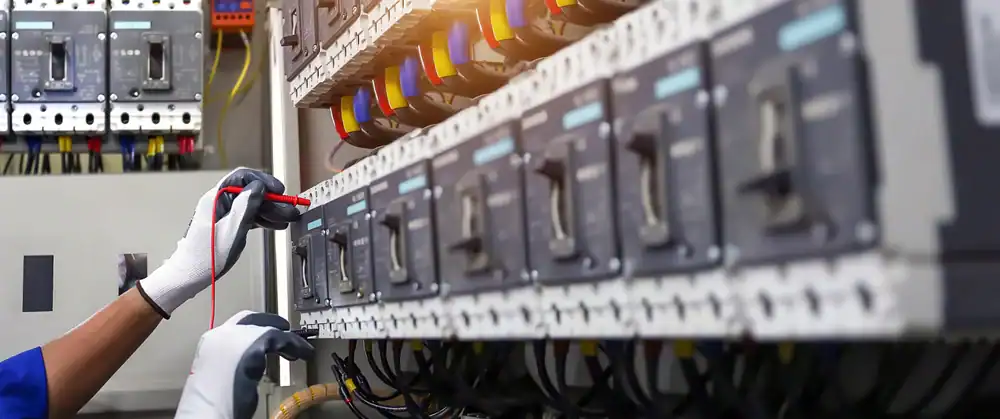
If you’ve ever heard an electrician mention three-phase power and nodded along without being entirely sure what it meant, you’re not alone. Most residential buildings run on single-phase power — two hot wires and a neutral, delivering 120 or 240 volts. It works fine for homes. It doesn’t work fine for commercial operations that run large motors, industrial HVAC systems, conveyor equipment, or manufacturing machinery.
Three-phase power uses three hot conductors instead of one, delivering power in a continuous, rotating sequence. The practical result is that it handles much higher loads more efficiently, with less energy lost per conductor. For a warehouse in Mebane, NC running conveyor systems, or a food processing operation in Burlington, NC running commercial refrigeration and production equipment, three-phase power isn’t optional — it’s the infrastructure the whole operation depends on.
The issue is that not every electrician who holds a contractor’s license has hands-on experience with three-phase systems. Residential electricians work with single-phase systems almost exclusively. Sending one into a commercial panel that feeds three-phase equipment is a code compliance risk and, in some cases, a safety one.
A qualified commercial electrical contractor has worked on these systems enough to troubleshoot them, upgrade them, and wire new equipment into them without guessing. That experience matters especially across Alamance County, where the commercial landscape includes a real mix of logistics operations, light manufacturing holdovers from the county’s textile era, and newer commercial development. These aren’t all the same electrical environments, and they don’t all have the same needs.
Here’s something that doesn’t get talked about enough: a lot of the electrical contractors operating in any given market built their business on new construction. They follow blueprints in empty buildings, rough in wire before the walls go up, and move on to the next project. That’s a legitimate business model. It’s just not the same thing as commercial service work.
Service work on existing buildings is a different skill set. You’re working in finished spaces, around live systems, troubleshooting problems you can’t always see. You’re not wiring from scratch — you’re figuring out why something stopped working, or why a panel that was fine five years ago can’t handle the load anymore, or why a circuit keeps tripping under conditions that shouldn’t be tripping it. That kind of diagnostic work takes a different kind of experience.
We started ESP Electrical Service Providers in 2002 because we saw this gap firsthand. Most electrical companies in Alamance County at the time were focused on new construction, and businesses with existing properties were being treated as low-priority service calls — fit in when there’s time, not a core part of the business. That’s still true in a lot of markets.
For businesses in Burlington, NC, Graham, NC, or anywhere else in Alamance County dealing with aging commercial buildings — and a lot of the county’s commercial stock dates to the 1950s through the 1980s — this distinction is especially relevant. Those buildings weren’t built for the electrical loads modern businesses put on them. Panel upgrades, service upgrades, rewiring for new equipment — that’s service work on existing properties, and it requires a contractor who actually specializes in it.
Want live answers?
Connect with a Electrical Service Providers expert for fast, friendly support.
When you call a commercial electrical contractor, the experience should feel different from calling a general handyman or a residential electrician who “also does commercial.” We show up ready — with the parts, the tools, and the specific experience to handle what you’ve got.
What that looks like in practice: a technician who can diagnose the problem without making three trips to a supply house, a price that’s fixed before work starts so you’re not watching the clock while someone troubleshoots, and work that passes inspection the first time so you’re not dealing with re-inspection fees or project delays. These aren’t extraordinary expectations. They’re what a qualified commercial electrical contractor should be able to deliver consistently.
Hourly billing is the default in most of the electrical contracting industry. For a straightforward residential job, it’s manageable. For a complex commercial job — a panel upgrade, a motor control installation, a three-phase service upgrade — it creates a real problem. The job takes longer than estimated, the electrician needs to make a supply run, something unexpected comes up behind the wall, and suddenly a job that was quoted at three or four hours turns into six or seven.
The business owner has no way to push back because they agreed to hourly billing.
Flat-rate pricing solves this. You know the number before work starts. That number doesn’t change because the job took longer or because the technician needed a part they didn’t have on the truck. For commercial clients managing vendor budgets and scheduling around operational needs, this isn’t just a nice feature — it’s a meaningful operational benefit.
We price all of our work this way. The number you hear before we start is the number on the invoice. If that sounds straightforward, it’s because it is — but it’s worth saying plainly because hourly billing is still the norm, and a lot of business owners don’t realize there’s an alternative until they’ve been burned by a runaway bill on a job that was supposed to be simple.
The other piece of this is what we carry on the truck. Our technicians arrive stocked for the most common commercial electrical jobs, which means most work gets done in a single visit. For a business that can’t have an electrician coming and going over three or four days, that matters. Every return trip is another day of disruption, and disruption costs money in ways that don’t always show up on the invoice.
Most people don’t know what to ask when they’re vetting an electrical contractor, which is how they end up hiring someone who isn’t the right fit. A few questions can tell you a lot before anyone sets foot on your property.
Start with licensing. In North Carolina, electrical contractors are licensed and regulated by the NC State Board of Examiners of Electrical Contractors. You can ask for a license number and verify it directly. A contractor who’s reluctant to provide one is a contractor worth walking away from. Beyond the standard contractor license, a Master Electrician designation is a higher individual credential that requires passing a separate examination — it’s not automatically granted with years of experience.
Ask specifically about commercial experience. Have they worked on three-phase systems? Have they done panel upgrades in existing commercial buildings? Do they pull permits and ensure the work passes inspection? These aren’t trick questions — they’re the basics, and a qualified commercial contractor should answer them without hesitation.
Ask about pricing before they start. If the answer is “we’ll see how long it takes,” that’s hourly billing, and you should know that going in. If they offer a flat-rate price before work begins, that’s a better position to be in.
For businesses in Alamance County, it’s worth asking whether the contractor has worked in the local market long enough to know local inspection requirements. Burlington, NC, Graham, NC, Mebane, NC, and the surrounding municipalities all have local jurisdictions responsible for issuing permits and enforcing electrical code. A contractor who knows those requirements gets work done right the first time. One who doesn’t may pass the job off to an inspector who sends them back to fix something — and that delay falls on you, not them.
We’ve been working in Alamance County since 2002. Andy Helton, our Master Electrician and owner, has been licensed since 1989. That’s not a credential we lead with to impress anyone — it’s context for what it means to have a contractor who actually knows this market, knows the inspection requirements, and has been doing this specific kind of work in this specific area for long enough that there aren’t many surprises left.
The short version: commercial electrical work requires a contractor who’s built their business around it — not one who does it on the side when new construction slows down. The systems are more complex, the stakes are higher, and the difference between a contractor who knows what they’re doing and one who doesn’t shows up in inspection results, job timelines, and final invoices.
If you’re running a business in Alamance County and you need electrical work done on an existing property — whether that’s a panel upgrade, a three-phase installation, motor control wiring, or emergency service — the contractor you call should be able to answer your questions clearly, price the job before they start, and finish it without making you wait.
We’ve been doing exactly that across Alamance County and the surrounding area since 2002. If you want to talk through what you’ve got going on, give us a call — a real person will pick up.
Article details:
Share:
Continue learning: