Not every licensed electrician is qualified for industrial work. Here's the verification checklist Alamance County facility managers and general contractors actually need before signing anything.
Share:
Summary:
Most guides on hiring industrial electrical contractors tell you to look for someone “licensed, experienced, and insured.” That’s true, but it’s not enough. In Alamance County, where facilities ranging from textile manufacturers to life sciences operations run complex three-phase systems and motor controls, the gap between a contractor who’s technically licensed and one who actually knows industrial electrical work can cost you weeks of downtime — or more. This guide cuts through the generic advice and gives you the specific things to verify, the right questions to ask, and the proof points that matter before you put your signature on anything.
This is the misconception that gets facility managers into trouble most often. A contractor who does excellent work wiring office buildings or retail spaces is not automatically qualified for industrial electrical services. Three-phase power distribution, motor control centers, machine wiring to NFPA 79 standards, load calculations for heavy equipment, inrush current management, power quality analysis — none of this exists in commercial or residential work at the same level of complexity.
When you’re dealing with a production environment, the stakes are different. Unplanned manufacturing downtime costs U.S. manufacturers an estimated $50 billion per year, according to Aberdeen Research. The average large manufacturing operation loses roughly $260,000 for every hour a critical line sits idle. That context changes how you should think about contractor selection — it’s not a cost decision, it’s a risk decision.
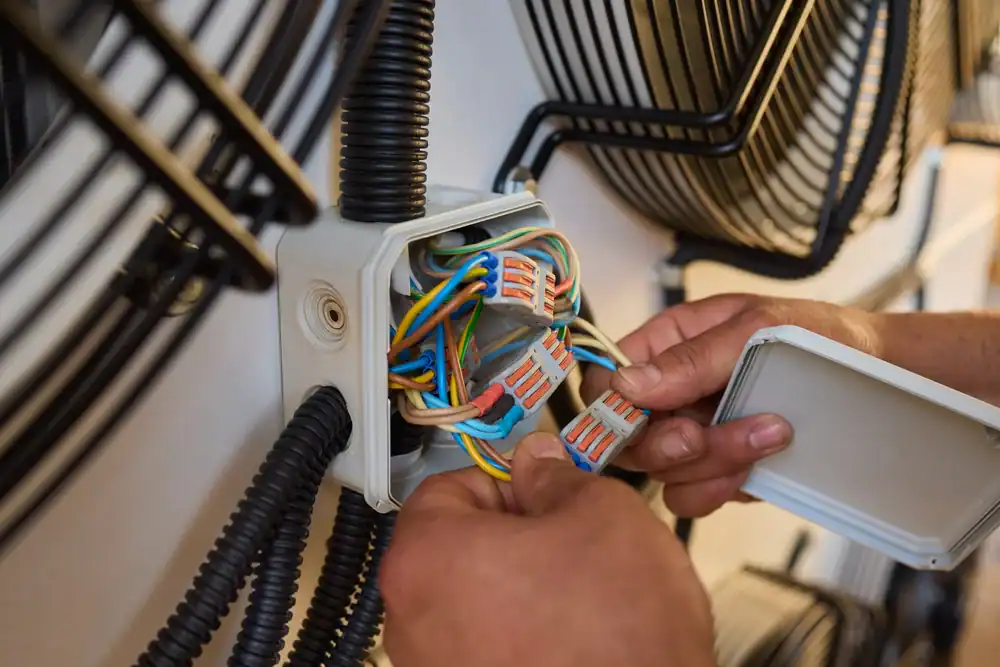
The scope of industrial electrical work goes well beyond running circuits or swapping breakers. A qualified industrial contractor handles three-phase power systems that feed heavy machinery, control panels that coordinate automated production lines, and machine wiring that runs from the disconnect all the way to the final control connection — accounting for load calculations, inrush current, control voltage stability, and grounding for sensitive electronics along the way.
Motor control troubleshooting is another area where the difference is stark. A contractor who doesn’t understand three-phase systems, power quality, and winding resistance testing will swap starters until something works and call it done. A contractor who does understand these systems will use a megohmmeter to test winding insulation, a power quality analyzer to read voltage imbalance across phases, and a thermal imaging camera to find hotspots before they become failures. One approach finds the root cause. The other finds it eventually — after you’ve paid for the parts they tried first.
Thermal imaging is worth calling out specifically because it’s one of the most underused diagnostic tools in industrial settings. A thermal scan of your electrical distribution panels, motor control centers, and connection points can surface problems that look fine to the naked eye — loose connections running hot, overloaded circuits, failing components — before they cause a shutdown. It’s the kind of proactive diagnostic capability that separates a contractor with genuine industrial depth from one who shows up when something breaks and figures it out from there.
The scheduling reality of industrial work matters too. A contractor who only works Monday through Friday, 8 to 5, and needs to pull parts from a supplier before starting is a contractor who will put your production schedule at risk. Industrial electrical work often has to happen during planned maintenance windows, on weekends, or after hours — and the contractor needs to arrive prepared to complete the job, not begin figuring out what they need.
North Carolina requires a license before any person, firm, or corporation engages in electrical contracting — that’s G.S. 87-43. The license is issued by the NC State Board of Examiners of Electrical Contractors (NCBEEC), and it comes in three classifications that matter more than most buyers realize.
A Limited license covers single projects up to $60,000. An Intermediate license covers projects up to $150,000. An Unlimited license carries no project value cap and is the appropriate credential for large-scale industrial work. All three classifications are technically authorized for industrial projects, but if your project scope exceeds $60,000 — which most meaningful industrial electrical projects do — you need a contractor holding at least an Intermediate license, and ideally an Unlimited one.
Here’s the part most buyers skip: you don’t have to take the contractor’s word for it. NC electrical contractor licenses are publicly searchable through the NCBEEC. You can verify the license classification, the license holder’s name, and the current status of the license before you sign anything. If a contractor tells you they’re licensed for the work but won’t give you their license number, that’s a signal worth paying attention to.
Beyond the contractor’s company license, ask whether the person actually performing the work holds a Master Electrician credential. A Master Electrician license requires demonstrated skills, experience, and passing a comprehensive exam — it’s a higher-tier credential than a journeyman license and signals a level of expertise that matters when the work involves complex industrial systems. NC also requires licensees to complete eight hours of continuing education per year to renew, which means a licensed contractor is required to stay current with code changes — including the National Electrical Code, which updates every three years.
For industrial facilities in Alamance County, one additional consideration is NFPA 70E compliance. NFPA 70E defines what a “qualified person” looks like for electrical work — someone who has demonstrated skills and knowledge related to the construction and operation of electrical equipment and has received safety training to identify and avoid the hazards involved. As a facility manager, you carry responsibility for ensuring the contractors working in your facility meet that standard. Ask for it directly.
Want live answers?
Connect with a Electrical Service Providers expert for fast, friendly support.
Alamance County has a deep industrial identity. Burlington was once home to what was, at its peak, the largest textile industry in the world — and that legacy has evolved into a diverse advanced manufacturing base that today includes aerospace, life sciences, food manufacturing, and distribution operations. Honda Power Equipment, Glen Raven, Labcorp, and Cambro are among the major employers operating facilities throughout the county, and the area continues to grow, positioned at the intersection of I-85 and I-40 between the Triad and Triangle metro areas.
That industrial base creates consistent, ongoing demand for exactly the kind of electrical work most general electricians aren’t equipped to handle — three-phase systems, motor control troubleshooting, machine wiring for new equipment installations, and power quality work in precision lab and manufacturing environments. It also means the cost of choosing the wrong contractor is particularly high here, where a production shutdown at a food processing or distribution facility isn’t an inconvenience — it’s a measurable financial event.
The questions most buyers ask are too general to be useful. “Are you licensed?” and “Do you have experience with industrial work?” will get you a yes from almost every contractor you call, regardless of whether that yes is accurate. The questions that actually surface the right information are more specific.
Ask what NC electrical contractor license classification they hold and request the license number so you can verify it yourself. Ask whether the technician performing the work holds a Master Electrician credential. Ask what diagnostic equipment they carry — a contractor who can name their megohmmeter, power quality analyzer, and thermal imaging camera is a contractor who actually uses them. Ask whether they give you a written price before work begins and whether that price changes if they overlooked something.
That last question matters more than most buyers realize. Hourly billing with no ceiling creates a dynamic where the contractor’s interests and your interests aren’t aligned. A flat-rate pricing model — where you approve an exact cost before work starts and that number holds even if the job turns out to be more complicated than expected — puts both parties on the same side. It’s not a standard practice across the industry, which is exactly why it’s worth asking about directly.
Ask about emergency availability too, and push past the generic answer. “24/7” is easy to say. What you want to know is whether a real person answers the phone at 2 a.m. on a Saturday, and whether a truck can be at your facility within hours — not the next business day. For industrial operations in Alamance County, where a motor control failure on a holiday weekend can halt production for days if the right contractor isn’t reachable, that question has a real dollar value attached to it.
Finally, ask about their inspection record. Work that doesn’t pass inspection the first time doesn’t just mean rework — it means delays, re-scheduling, and in some cases, halted operations while you wait for a re-inspection. A contractor with a consistent track record of first-time inspection passes is a contractor who does the work correctly the first time, which is the only version of the job that actually saves you money.
Two operational details that don’t get enough attention in contractor selection conversations are pricing structure and truck inventory — and both of them have a direct impact on your total cost and your downtime exposure.
On pricing: the difference between hourly billing and flat-rate pricing isn’t just about predictability, though that matters. It’s about incentive alignment. An hourly billing model means a slower job costs you more. A flat-rate model means the contractor has every reason to work efficiently, because their margin doesn’t grow with the clock. When you’re managing a facility where downtime has a measurable hourly cost, the pricing structure of your electrical contractor is not a minor detail.
On truck inventory: a contractor who shows up, assesses the job, and then leaves to pull parts from a supplier has already cost you hours. For most industrial electrical repairs and installations, the materials needed are predictable — a contractor who has been doing this work for decades knows what to carry. A fully stocked truck means most jobs can be completed in a single visit, which is the difference between a half-day event and a multi-day ordeal when a motor control panel fails mid-shift.
For facilities in Alamance County — where operations like food manufacturing and distribution run on tight schedules and where the county’s position between two major metro areas makes it a hub for time-sensitive logistics — these details are worth confirming before you sign. Ask whether the contractor dispatches fully stocked trucks. Ask what happens if the job requires a part they don’t have on the truck. The answers will tell you a lot about how they actually operate versus how they describe themselves.
One more thing worth confirming: financing. For smaller industrial and commercial facilities managing capital budgets, the availability of financing on electrical projects can be the difference between addressing an aging panel or outdated motor control system now versus deferring it — and deferred electrical maintenance in industrial settings carries real risk. Not every contractor offers it, so it’s worth asking upfront.
The right industrial electrical contractor isn’t just one who says yes to the job. It’s one who can verify their NC license classification, name the diagnostic tools they carry, give you a written price before work starts, and answer the phone when something fails on a Saturday night. Those aren’t high bars — but they’re bars that narrow the field considerably.
Alamance County’s industrial base — from the advanced manufacturers along I-85 to the life sciences and food processing operations throughout Burlington and the surrounding areas — deserves contractors who actually understand industrial electrical systems, not ones who are willing to figure it out on your floor.
If you’re in the process of vetting contractors for an upcoming project, or if you’ve been burned before and want to get this one right, we’ve been doing this work in Alamance County since 2002. Call us and a real person will pick up.
Article details:
Share:
Continue learning: